The 4Cs of Diamonds
Understand cut, color, clarity, and carat—and learn where each grade matters most.
The 4Cs—cut, color, clarity, and carat weight—are the standard framework used to describe and compare diamonds. They give shoppers a common language for evaluating quality, but they are not four equally important boxes to maximize. The smartest diamond purchase usually comes from understanding which characteristics have the greatest effect on what you actually see and which grades can be adjusted without sacrificing beauty.
Quick rule: prioritize cut first, then balance color, clarity, and carat according to the diamond shape, setting, metal, and your personal preferences.
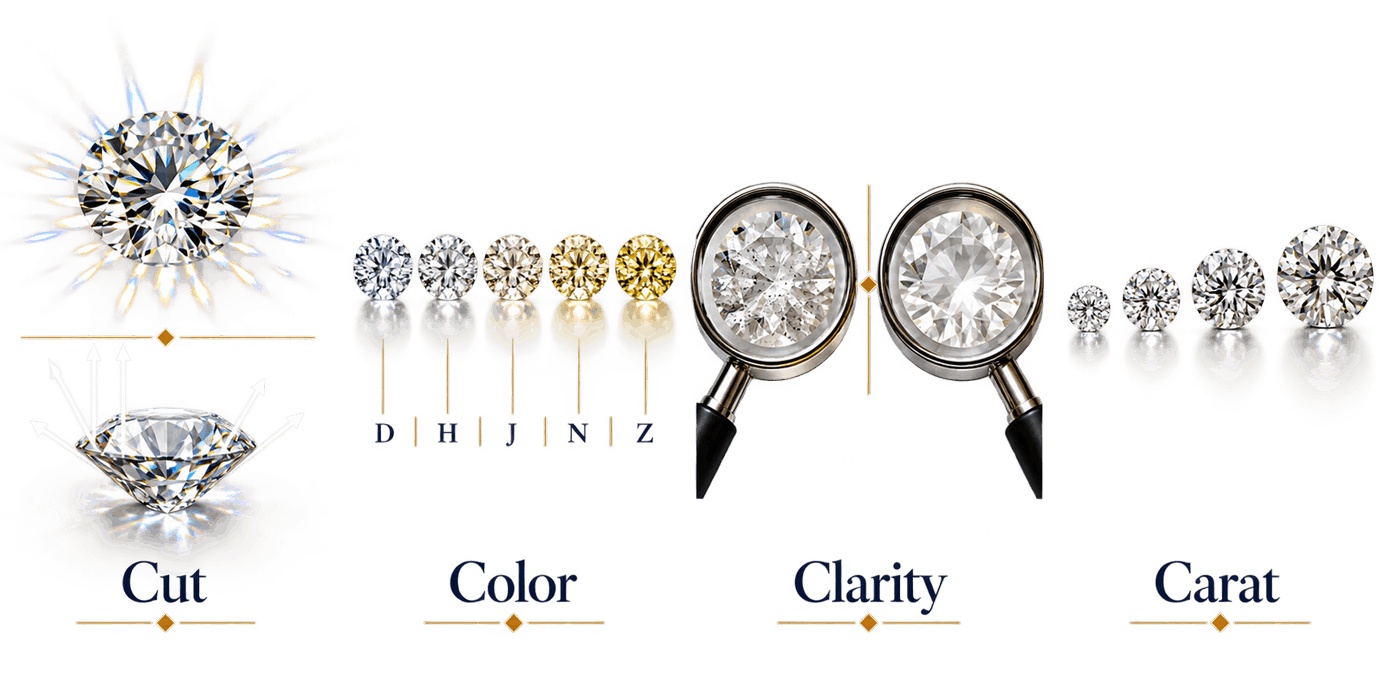
The 4Cs at a Glance
Cut
How effectively a diamond’s proportions and facets interact with light. Cut has a major influence on brilliance, fire, and sparkle.
Color
How colorless or noticeably warm a diamond appears. Less visible color generally receives a higher grade in the traditional D-to-Z system.
Clarity
The presence and visibility of internal inclusions and external blemishes. The goal for many shoppers is an attractive, eye-clean diamond.
Carat
A measurement of diamond weight, not visible size. Two diamonds with the same carat weight can look very different face-up.
Why the 4Cs Matter
Diamonds vary enormously, even when they appear similar in a product title or photograph. Two one-carat diamonds can differ in brightness, visible size, color, clarity, proportions, and price.
The 4Cs provide a structured way to describe those differences. Each characteristic affects either the appearance, rarity, weight, or market value of the diamond.
But grades should not be treated like a scorecard where the goal is simply to max out every category. A diamond with the highest possible color and clarity grades is not automatically the most beautiful or best-value stone for every shopper.
Cut: The Most Important C for Sparkle
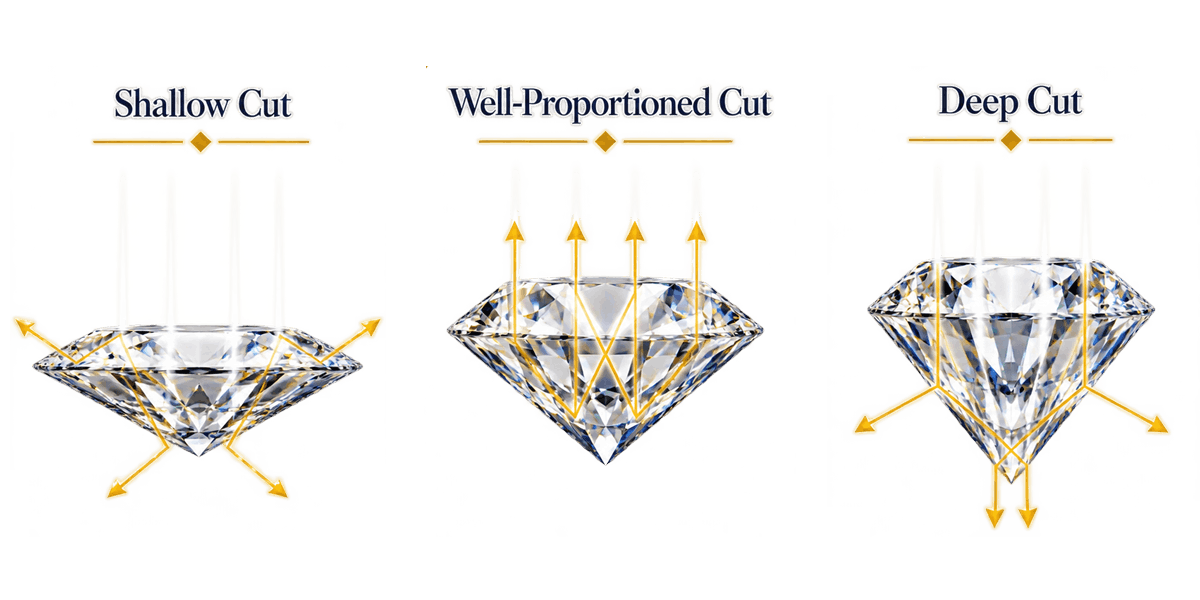
Cut describes how successfully a diamond has been fashioned from rough material into a finished gemstone. In a well-cut diamond, proportions and facets work together to return light through the top of the stone in an attractive pattern.
This interaction produces the visual effects commonly described as brilliance, fire, and scintillation.
Brilliance
The white light returned from a diamond to the viewer.
Fire
Flashes of spectral color created as white light is dispersed.
Scintillation
The pattern of bright and dark flashes seen as the diamond, light source, or viewer moves.
Pattern
The arrangement of contrasting light and dark areas across the face of the diamond.
If a diamond is cut too deeply or too shallow, more light can escape rather than returning to the viewer. The result may appear darker, less lively, or smaller than expected for its carat weight.
If you have to compromise somewhere, be careful about compromising on cut. A slightly lower color or clarity grade can still look beautiful. Weak light performance is much harder to hide.
Cut Grade vs. Diamond Shape
Cut and shape are related but different. Shape describes the outline—round, oval, emerald, pear, radiant, cushion, and so on. Cut quality describes how effectively the stone’s proportions and facets work together.
Formal overall cut grades are most standardized for round brilliant diamonds. Fancy shapes often require more visual evaluation because proportions that look attractive in one oval, radiant, cushion, or pear may not produce the same result in another.
For fancy shapes, symmetry, facet pattern, bow-tie effect, depth, table size, outline, and length-to-width ratio can all contribute to appearance.
For more detail, visit Diamond Shapes.
Color: How White or Warm Does the Diamond Look?
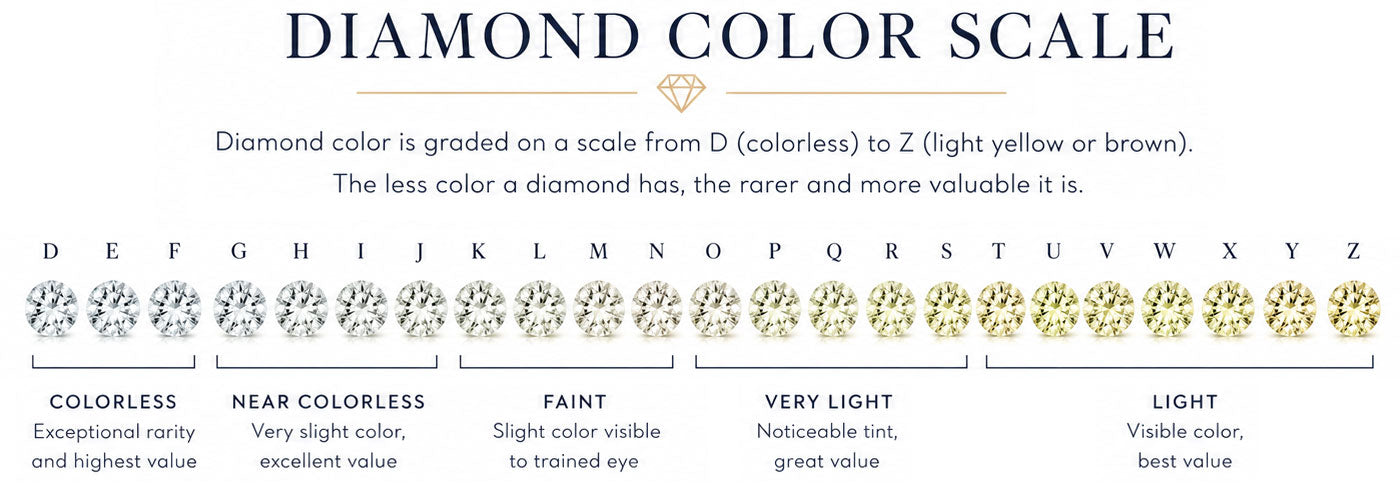
For traditional white diamonds, color is graded according to how much body color is present. The widely used grading scale runs from D through Z, with D representing the highest colorless range and increasing warmth generally becoming more noticeable farther down the scale.
| Color Range | General Description | What Shoppers May Notice |
|---|---|---|
| D–F | Colorless | Very little visible body color; often preferred when maximum whiteness is important. |
| G–J | Near Colorless | Can appear very white face-up, especially in well-cut stones and appropriate settings. |
| K–M | Faint Color | Warmth becomes more noticeable and can work beautifully in certain designs and warmer metals. |
| N–Z | Increasingly Noticeable Color | Body color becomes progressively more visible. |
Do You Need a D-Color Diamond?
No. A D-color diamond can be beautiful, but many shoppers would have difficulty distinguishing certain adjacent color grades once a diamond is mounted and viewed face-up.
That creates one of the most useful opportunities for balancing quality and budget. Instead of paying a significant premium for an extremely high color grade, some shoppers choose a near-colorless diamond and allocate more of the budget toward cut, carat weight, or the setting.
The right color depends heavily on personal sensitivity to warmth, diamond shape, size, and setting metal.
Diamond Shape Affects Visible Color
Some shapes can show body color more readily than others. Round brilliant diamonds can be efficient at returning light and may visually mask some warmth. Elongated and fancy shapes—including oval, pear, marquise, emerald, radiant, and cushion—may reveal color differently, particularly near their ends or in larger stones.
Step-cut shapes such as emerald and Asscher can also make subtle characteristics more apparent because they contain broad, open facets rather than the highly fragmented reflections of brilliant-style cuts.
Metal Color Can Change the Equation
White Gold & Platinum
Bright white metals can make warmth in a diamond somewhat easier to notice, particularly from the side.
Yellow Gold
Warm metal can make a slightly warmer diamond feel harmonious and may reduce the need to chase extremely high color grades.
Rose Gold
The rosy tone creates a warm visual environment that can complement diamonds with subtle body color.
Two-Tone Settings
A white metal head with a yellow or rose gold band can maintain a bright look around the diamond while preserving the desired band color.
Clarity: What Is Inside the Diamond?
Clarity evaluates internal characteristics called inclusions and external characteristics called blemishes.
These can include crystals, feathers, clouds, needles, pinpoints, surface features, or other characteristics. Lab-grown diamonds can also contain inclusions associated with their growth process.
Clarity grading considers the size, number, location, nature, and visibility of these characteristics.
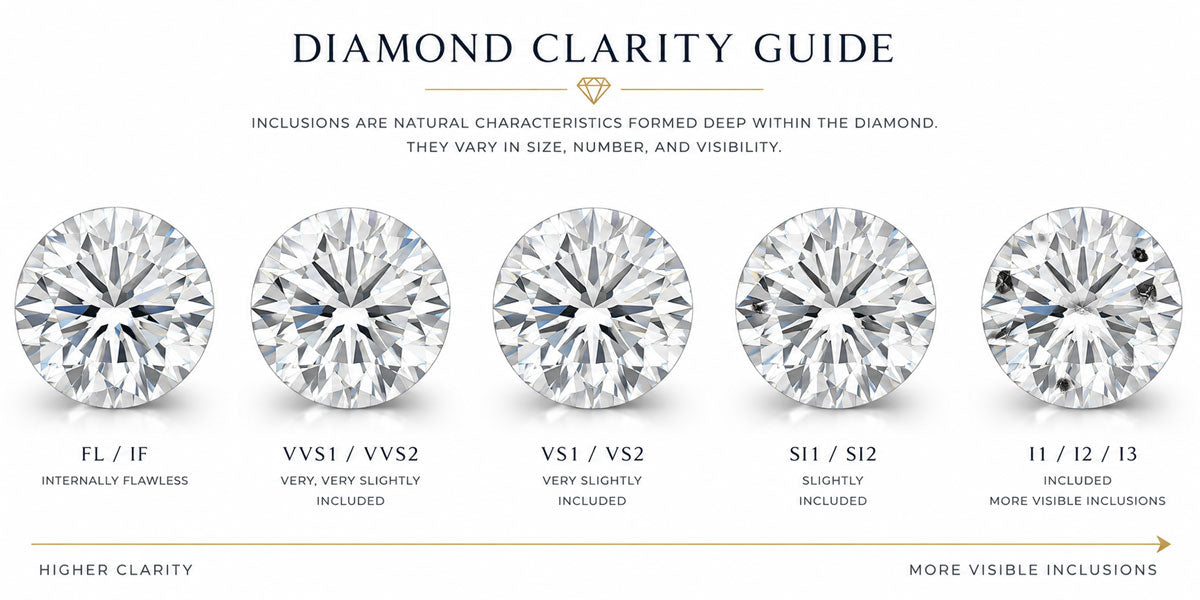
Understanding the Clarity Scale
| Grade | Name | General Meaning |
|---|---|---|
| FL | Flawless | No inclusions or blemishes visible under standard 10× magnification to a skilled grader. |
| IF | Internally Flawless | No inclusions visible at 10×, though minor surface blemishes may be present. |
| VVS1–VVS2 | Very, Very Slightly Included | Inclusions are extremely difficult to see under 10× magnification. |
| VS1–VS2 | Very Slightly Included | Minor inclusions are visible under magnification but may be difficult for the unaided eye to detect. |
| SI1–SI2 | Slightly Included | Inclusions are easier to see under magnification and may sometimes be visible without magnification. |
| I1–I3 | Included | Inclusions are obvious under magnification and may affect transparency, appearance, or durability. |
What Does “Eye-Clean” Mean?
“Eye-clean” is a practical jewelry-shopping term rather than an official laboratory grade. It generally means that inclusions are not readily visible to the unaided eye under normal viewing conditions.
This concept is useful because characteristics that are obvious under 10× magnification may be extremely difficult to see when the diamond is actually worn.
For many shoppers, an attractive eye-clean VS or SI diamond can represent better value than paying a large premium for microscopic perfection that creates little visible difference.
Do not buy a clarity grade simply because the letters are higher. Ask whether the inclusions affect beauty, transparency, durability, or what you can actually see.
Clarity Matters Differently by Shape
Brilliant-style facet patterns create many reflections and flashes that can make certain inclusions less noticeable. Round, radiant, cushion, princess, oval, pear, and marquise diamonds can therefore offer some flexibility.
Emerald and Asscher cuts contain large open facets that provide a clearer view into the stone. In these shapes, inclusions may be easier to notice, making careful clarity selection more important.
Carat Weight: What a Diamond Weighs
Carat is a unit of weight. One carat equals 200 milligrams.
Carat weight does not directly measure diameter, length, width, or visible surface area. That distinction matters because diamonds distribute their weight differently depending on shape and proportions.
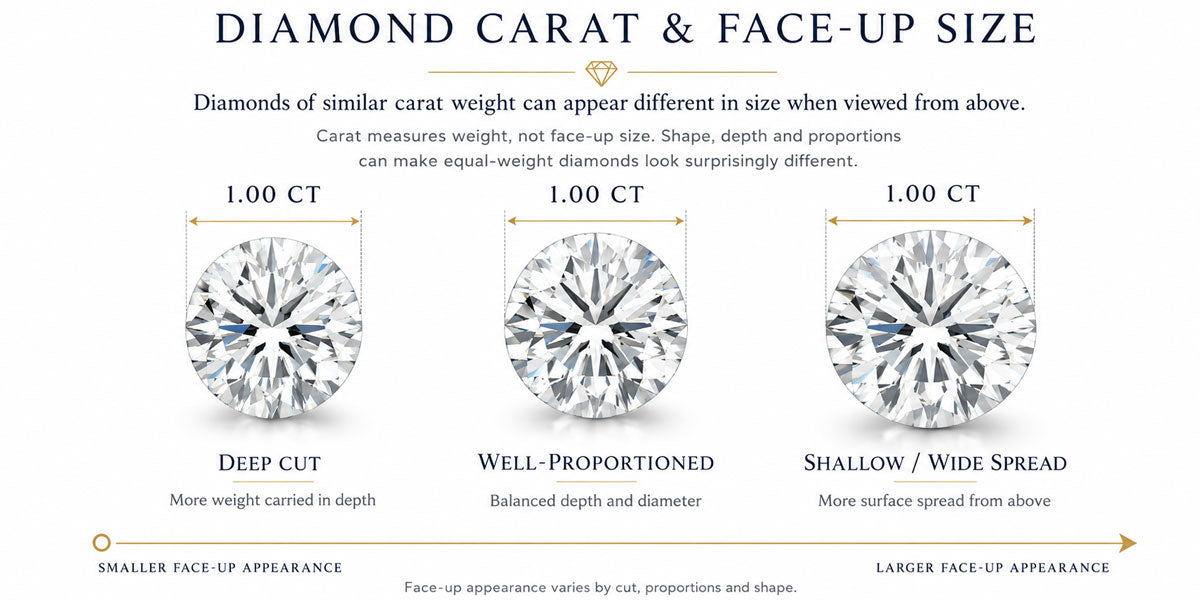
Carat Weight vs. Visual Size
Carat = Weight
It tells you how much the diamond weighs.
Dimensions = Visible Size
Length, width, and diameter provide a better indication of how large the diamond will look.
Shape Changes Spread
Oval, pear, and marquise diamonds can provide greater visible spread than some other shapes of the same weight.
Setting Changes Perception
Halos, thin bands, side stones, and setting proportions can make the same diamond appear larger or smaller.
Why Diamond Prices Jump at Certain Carat Weights
Diamond pricing does not increase in a perfectly straight line as weight increases. Certain milestone weights—such as 1.00, 1.50, 2.00, and 3.00 carats—can attract additional demand.
A diamond weighing just below a milestone may sometimes offer similar visual size at a lower price, depending on proportions and market conditions.
For example, a well-proportioned 1.90-carat diamond may look extremely similar to some 2.00-carat stones while avoiding part of the premium associated with crossing the two-carat threshold.
Which of the 4Cs Is Most Important?
| If Your Priority Is... | Consider Emphasizing... |
|---|---|
| Maximum Sparkle | Cut and overall visual performance |
| Largest Appearance | Carat, measurements, shape, and proportions |
| Bright White Appearance | Color, while considering metal and shape |
| Clean Appearance | Clarity sufficient to look eye-clean |
| Best Overall Value | Strong cut with balanced color and clarity rather than maximizing every grade |
The 4Cs and Lab-Grown Diamonds
The same fundamental quality concepts apply when evaluating lab-grown diamonds. Lab diamonds vary in cut, color, clarity, carat weight, shape, proportions, and overall visual performance just as natural diamonds do.
The biggest difference for shoppers is often the pricing structure. Because lab diamonds generally cost less than comparable natural diamonds, buyers may have more flexibility to move upward in carat weight, color, clarity, or overall jewelry design.
That does not mean every lab diamond should be purchased at extremely high grades. The same value principle applies: spend where the difference matters visually.
A Practical Lab Diamond Strategy
- Choose the diamond shape you genuinely prefer.
- Prioritize strong cut and attractive visual performance.
- Select a color grade that looks appropriately white in the chosen shape and metal.
- Choose enough clarity for an eye-clean appearance rather than paying automatically for microscopic perfection.
- Compare measurements as well as carat weight.
- Use the remaining budget to determine whether greater size, better quality, or a more elaborate setting matters most.
Do You Need the Highest Grades?
Usually not.
A D-color, flawless diamond sits at the top of traditional grading scales, but the visual difference between that stone and a carefully selected diamond with lower grades may be surprisingly small once both are mounted and viewed normally.
The best-value zone often lies where additional grade improvements stop producing meaningful visible improvements for the individual shopper.
How the 4Cs Work Together
The 4Cs should never be evaluated completely independently.
A larger diamond may make color and inclusions easier to notice. An emerald cut may reveal clarity characteristics that a brilliant cut hides. Yellow gold may make a warmer color grade perfectly attractive. Exceptional cut can make a diamond appear brighter and more visually impressive.
The goal is balance. Find the combination of cut, color, clarity, and carat that creates the look you want without paying for qualities you cannot appreciate.
Beyond the 4Cs
The 4Cs are important, but they do not describe everything that makes a diamond attractive.
- Diamond shape
- Length-to-width ratio
- Millimeter dimensions
- Table and depth proportions
- Symmetry
- Polish
- Facet pattern
- Bow-tie effect in certain fancy shapes
- Fluorescence
- Transparency
- Setting design and craftsmanship
- Metal color
- How the diamond actually looks to you
Certification and the 4Cs
Independent gemological reports can provide standardized information about a diamond’s characteristics. Depending on the laboratory and report, this may include carat weight, color, clarity, measurements, proportions, polish, symmetry, and identification of natural or laboratory-grown origin.
A grading report is an important source of information, particularly for significant center stones, but it should complement rather than replace visual evaluation.
Two diamonds with similar information on paper can still have noticeably different personalities.
How to Use the 4Cs When Shopping
- Choose your shape. Decide what outline and style you actually like.
- Set a realistic budget. This keeps comparisons relevant.
- Prioritize cut. Look for strong visual performance.
- Choose a sensible color range. Factor in shape, size, and metal.
- Find eye-clean clarity. Do not automatically pay for microscopic characteristics you cannot see.
- Compare carat and measurements. Make sure the stone looks as large as you expect.
- Evaluate the whole piece. The setting, proportions, metal, and craftsmanship matter too.
For the complete shopping process, continue to the Lab Diamond Buying Guide.
Frequently Asked Questions About the 4Cs
What are the 4Cs of diamonds?
The 4Cs are cut, color, clarity, and carat weight. Together they provide a standardized framework for describing important diamond characteristics.
Which of the 4Cs is most important?
Cut is generally the most important factor for brilliance and light performance. The ideal balance of color, clarity, and carat depends on the shopper’s priorities.
Is carat the same as diamond size?
No. Carat measures weight. Visible size depends on the diamond’s dimensions, shape, depth, proportions, and setting.
What clarity grade should I buy?
Many shoppers prioritize an eye-clean appearance rather than a specific letter grade. The ideal clarity depends on diamond size, shape, inclusion location, and personal preference.
What diamond color is best?
There is no single best color grade. D through F represents the colorless range, while many near-colorless diamonds can appear very white when mounted. Shape, size, setting metal, and sensitivity to warmth all matter.
Do the 4Cs apply to lab diamonds?
Yes. Lab-grown diamonds can be evaluated for cut, color, clarity, and carat weight, along with other characteristics such as proportions, measurements, polish, and symmetry.
Find Your Lab Diamond Jewelry
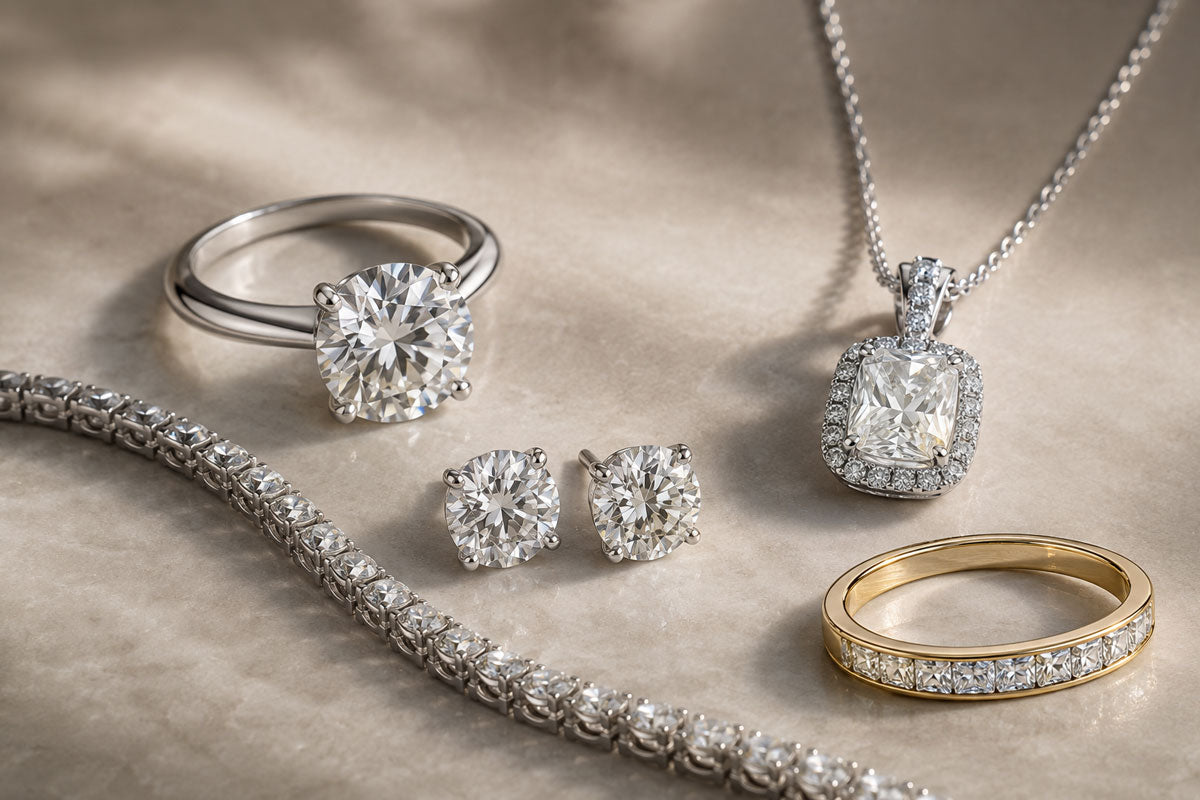
Shop rings, earrings, necklaces, bracelets, tennis jewelry, and newly added lab diamond designs.