Lab Diamond Buying Guide
A practical step-by-step guide to choosing a lab diamond that looks beautiful and fits your priorities.
Buying a lab diamond gets much easier once you stop trying to maximize every grade and start with the look you actually want. Shape, cut, color, clarity, carat weight, proportions, certification, setting style, and budget all matter, but they do not matter equally for every shopper. The best lab diamond purchase usually comes from balancing those factors intelligently rather than chasing the highest specifications on paper.
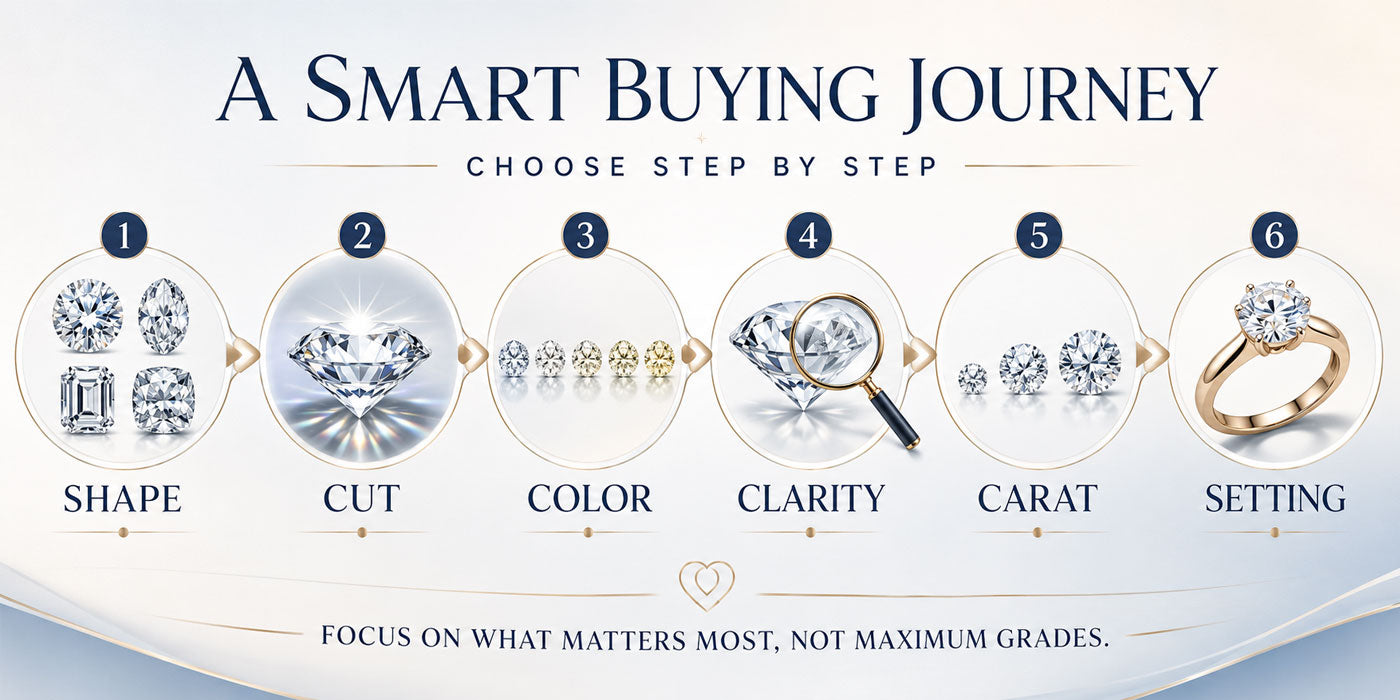
The simple strategy: choose your shape first, prioritize cut and visual performance, select sensible color and clarity, compare actual measurements, and spend the rest of the budget where it creates a difference you can actually see.
Step 1: Set Your Budget
Establishing a realistic budget makes the rest of the process dramatically easier. Without one, diamond shopping can become an endless comparison of increasingly larger stones and higher grades.
Think about the budget for the entire finished piece, not only the loose diamond. The setting, precious metal, side stones, pavé, craftsmanship, and design can represent a meaningful portion of the final price.
Lab diamonds generally provide more buying power than natural diamonds, which means the question often becomes how you want to use that flexibility.
Go Larger
Put more of the budget into center-stone size or total diamond weight.
Upgrade Quality
Keep the desired size and move upward in cut, color, clarity, or visual performance.
Upgrade the Setting
Allocate more toward platinum, side stones, pavé, halos, or distinctive craftsmanship.
Balance Everything
Choose sensible specifications throughout and avoid paying for differences you cannot appreciate.
Step 2: Choose Your Diamond Shape
Shape is usually the best place to begin because it immediately defines the personality of the jewelry. It also affects apparent size, sparkle pattern, color sensitivity, clarity requirements, proportions, and setting options.
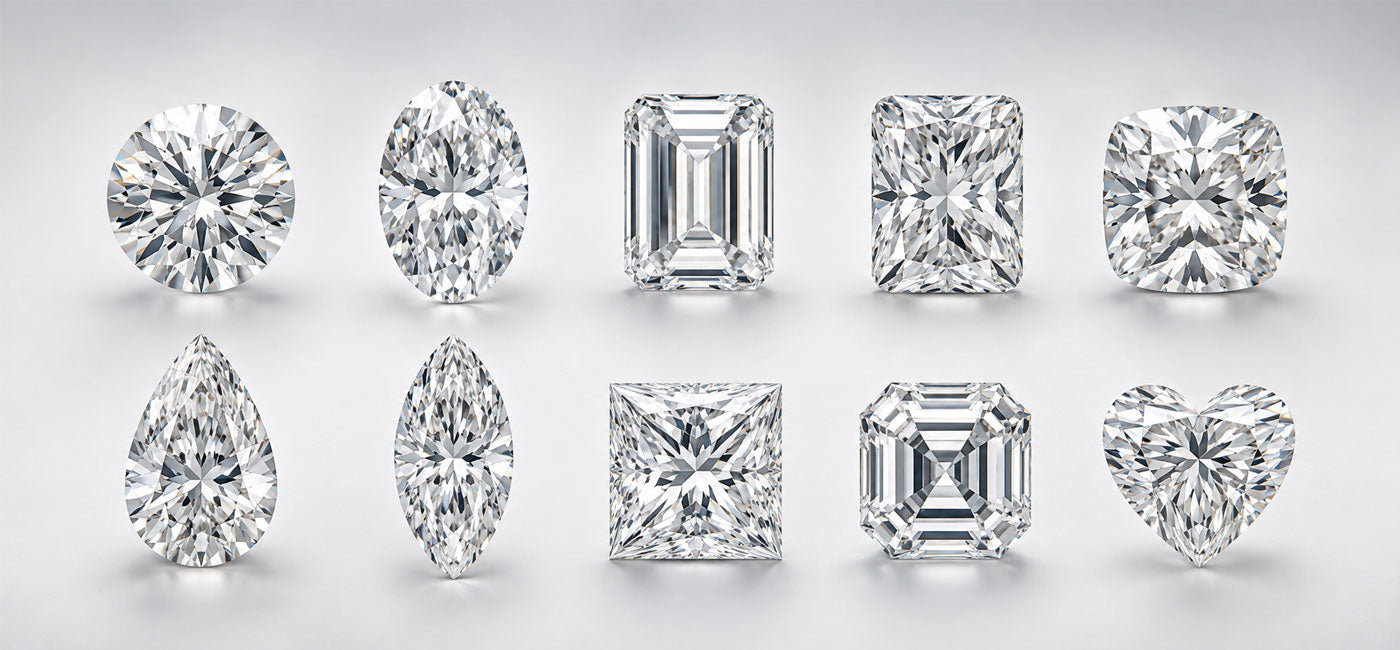
| Shape | General Character | Especially Good For |
|---|---|---|
| Round | Classic and highly brilliant | Timeless sparkle and maximum versatility |
| Oval | Elegant and elongated | Excellent visual spread and graceful proportions |
| Emerald | Clean and architectural | Step-cut sophistication and broad flashes of light |
| Radiant | Geometric with lively brilliance | Rectangular styling with more scintillation |
| Cushion | Soft and romantic | Vintage influence and rounded silhouettes |
| Pear | Distinctive teardrop | Elegant elongation and individual style |
For a complete comparison, see Diamond Shapes.
Step 3: Prioritize Cut and Visual Performance
Cut has a major influence on how a diamond handles light. A well-proportioned diamond can appear bright, lively, and visually substantial, while a poorly proportioned stone can look dark or hide unnecessary weight below the surface.
For round brilliant diamonds, formal cut grading offers useful guidance. Fancy shapes require more visual judgment because attractive proportions can vary considerably from stone to stone.
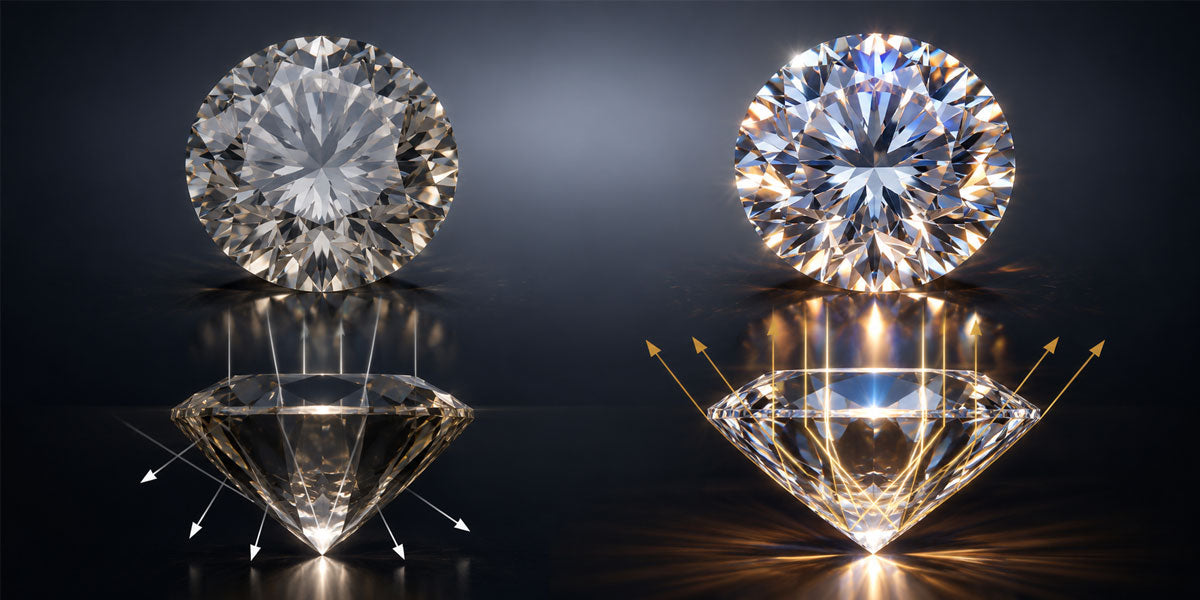
Do not sacrifice cut simply to reach a carat milestone. Sparkle and visual balance are generally much more noticeable than the number printed on a grading report.
Step 4: Choose a Sensible Color Grade
Diamond color is commonly evaluated on a D-to-Z scale, with D representing the highest colorless range and increasing warmth appearing farther down the scale.
For many shoppers, excellent value exists below the highest grades. A near-colorless diamond can still appear beautifully white once mounted, especially when it is well cut.
D–F
Colorless range. Appropriate when maximum whiteness is a strong priority.
G–H
Often an excellent balance of bright appearance and value.
I–J
Can remain very attractive depending on shape, size, and setting metal.
K and Below
Increasing warmth becomes more visible and can work beautifully with yellow or rose gold.
Step 5: Buy Enough Clarity—Not Necessarily the Highest Clarity
Clarity describes internal inclusions and external blemishes. The practical question for most shoppers is whether those characteristics affect appearance, transparency, or durability.
A diamond does not need to be flawless to look flawless during normal wear.
For many buyers, “eye-clean” matters more than the letters on the report. If you cannot see an inclusion without magnification and it does not create a durability concern, paying substantially more to eliminate it may provide little visible benefit.
Brilliant-style shapes can often disguise inclusions through their busy reflection patterns. Emerald and Asscher cuts have broader open facets and may reward more careful clarity selection.
Step 6: Understand Carat Weight vs. Visible Size
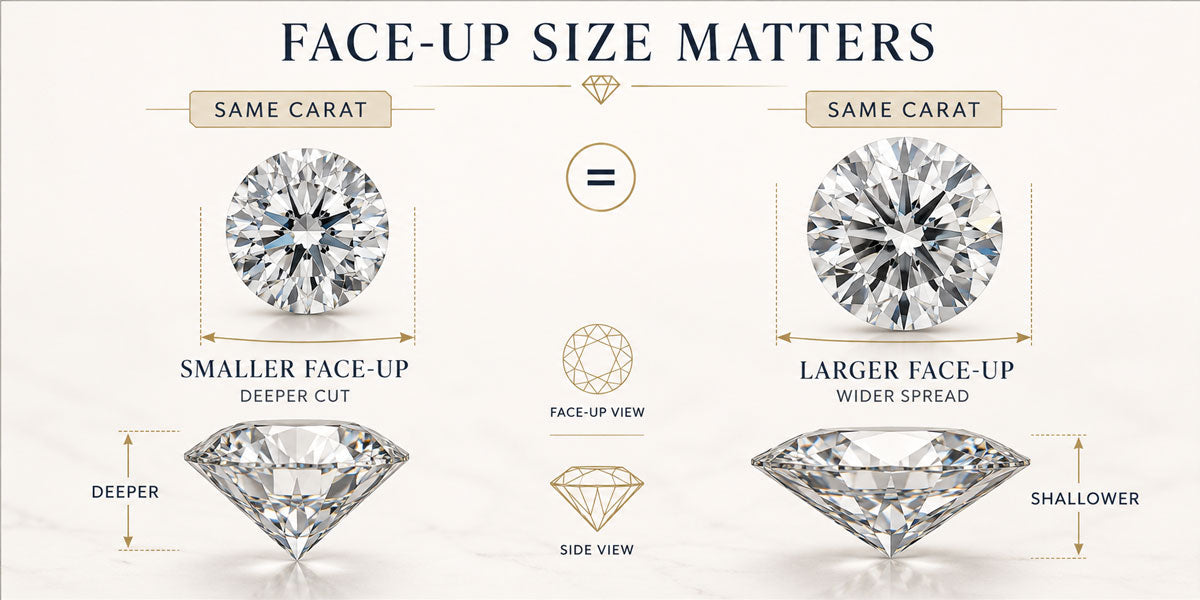
Carat measures weight—not diameter, width, length, or visible surface area.
Two diamonds can have exactly the same carat weight and look surprisingly different when viewed from above.
Check Measurements
Length, width, and diameter help tell you how large the diamond will actually appear.
Watch Excessive Depth
A deeply proportioned stone can hide weight below the girdle.
Use Shape Strategically
Oval, pear, and marquise diamonds often provide excellent visual spread.
Consider the Setting
Band width, halos, side stones, and mounting proportions can change perceived size.
Step 7: Compare Length-to-Width Ratio
For fancy shapes, length-to-width ratio can completely change the diamond's personality.
An oval may look full and rounded or long and slender. A radiant may be nearly square or distinctly rectangular. Cushions range from traditional square silhouettes to modern elongated forms.
There is no universal perfect ratio. Treat proportion as a preference rather than a grade to maximize.
Step 8: Watch for Bow-Tie Effects
Oval, pear, marquise, and some elongated fancy diamonds can display a darker central area commonly called a bow-tie effect.
A mild bow tie is common and not automatically undesirable. The important question is whether it becomes dark or prominent enough to distract from the overall appearance.
Because bow-tie intensity is difficult to summarize with a single number, visual comparison is particularly useful.
Step 9: Review the Gemological Report
Many significant lab diamonds are accompanied by independent gemological documentation. These reports provide standardized information and identify laboratory-grown origin.
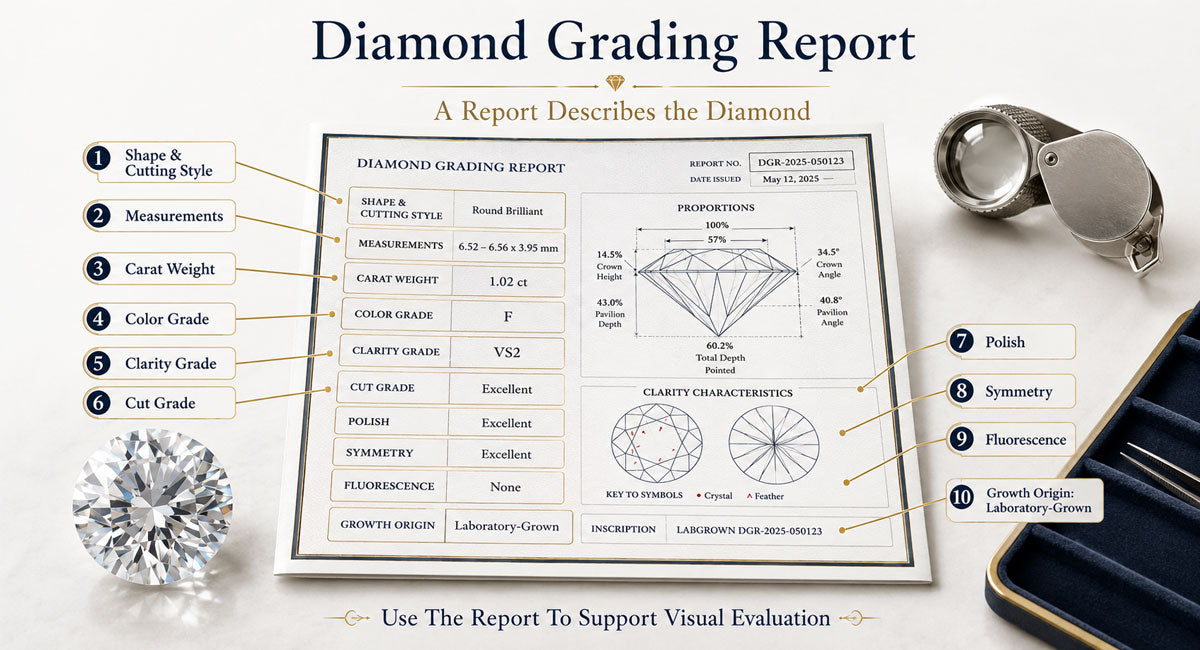
Depending on the laboratory and report, information may include:
- Carat weight
- Color grade
- Clarity grade
- Measurements
- Proportions
- Polish
- Symmetry
- Fluorescence
- Laboratory-grown identification
- Report number
- Additional growth or treatment information when applicable
A grading report is not a beauty guarantee. Two diamonds with similar grades can still look noticeably different because proportions, facet pattern, transparency, and overall visual character vary.
Step 10: Understand HPHT and CVD
Most gem-quality laboratory-grown diamonds are created using either High Pressure High Temperature or Chemical Vapor Deposition.
HPHT
High Pressure High Temperature uses intense pressure and heat to create conditions in which carbon can crystallize as diamond.
CVD
Chemical Vapor Deposition uses carbon-containing gases and a diamond seed to grow diamond material over time.
Neither method automatically produces a superior-looking diamond. For most shoppers, the quality of the finished stone is much more important than the growth method.
Step 11: Choose the Setting
The center diamond and mounting should be chosen as a complete design. A beautiful stone can be diminished by an unsuitable setting, while the right mounting can enhance its proportions and personality.
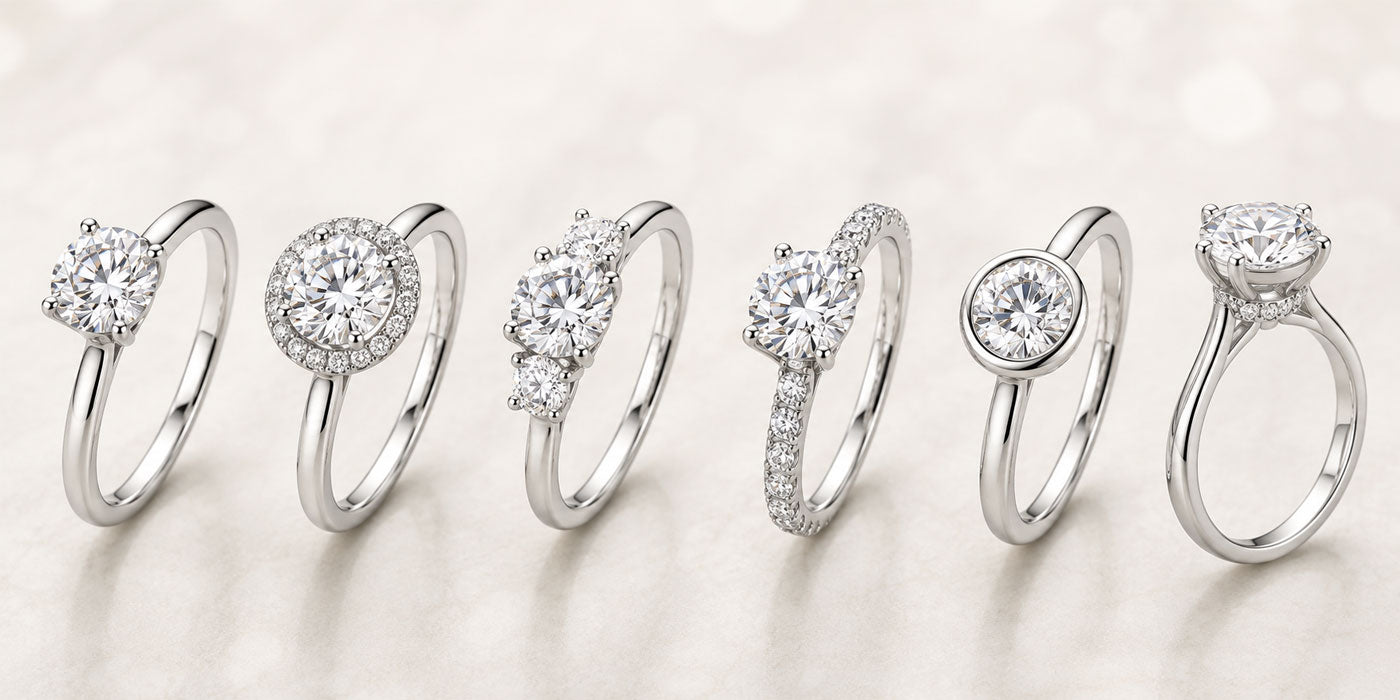
Solitaire
Keeps attention on the center diamond and works with nearly every shape.
Halo
Surrounds the center stone with smaller diamonds and increases visual presence.
Three-Stone
Adds side diamonds for additional coverage and a balanced composition.
Pavé
Adds small diamonds along the mounting for sparkle beyond the center stone.
Bezel
Surrounds more of the edge in metal for a clean appearance and additional protection.
Hidden Halo
Adds accent diamonds beneath the center for sparkle visible from side angles.
Step 12: Choose the Metal
| Metal | Visual Effect | General Character |
|---|---|---|
| White Gold | Bright and cool | Versatile and visually seamless with white diamonds |
| Yellow Gold | Warm contrast | Classic and equally at home in traditional or modern jewelry |
| Rose Gold | Soft pink warmth | Romantic and distinctive |
| Platinum | Naturally white | Dense, durable, and often selected for premium mountings |
Step 13: Evaluate the Entire Piece
It is easy to spend so much time comparing center-stone specifications that the rest of the jewelry becomes an afterthought.
Look at:
- Prong placement and security
- Band width and proportions
- Metal weight
- Side-stone quality
- Setting height
- Comfort
- Wedding-band compatibility when applicable
- Clasp construction on bracelets and necklaces
- Overall craftsmanship
- How the diamond and mounting look together
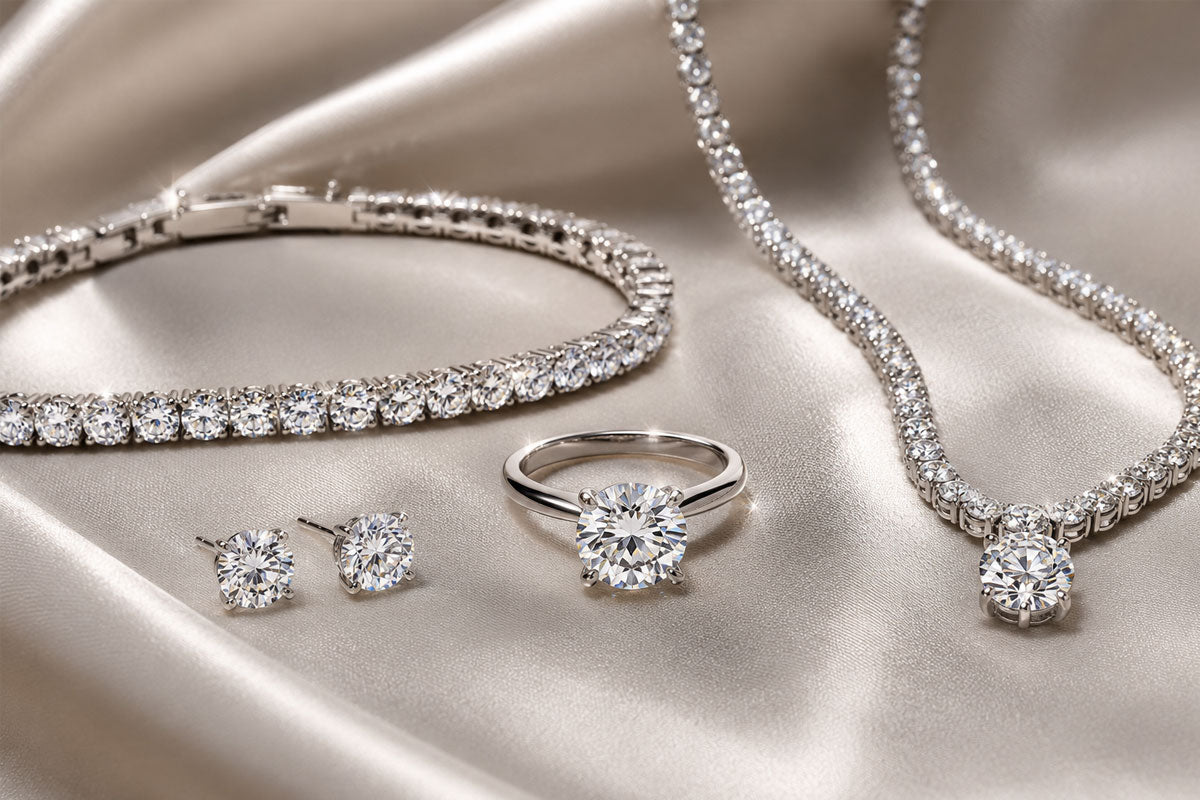
Buying Lab Diamond Stud Earrings
Stud earrings are one of the easiest places to take advantage of lab diamond value because visual size matters and the design places the diamonds front and center.
- Remember that total carat weight generally represents both earrings combined.
- Look for stones matched in diameter, color, shape, and overall appearance.
- Prioritize brightness and attractive cut.
- Do not automatically overpay for extremely high clarity.
- Choose secure backs appropriate for the size of the earrings.
Buying a Lab Diamond Tennis Bracelet
A tennis bracelet contains many diamonds, so consistency becomes important. Individual stones should work together as a continuous line rather than drawing attention to obvious differences.
Consider total carat weight, bracelet length, individual stone size, setting construction, clasp security, flexibility, and how the bracelet sits on the wrist.
Buying a Lab Diamond Tennis Necklace
Tennis necklaces amplify the same considerations on a larger scale. Because diamonds extend around much of the neck, total weight and construction can become substantial.
- Total carat weight
- Necklace length
- Graduated versus uniform diamond size
- Flexibility and articulation
- Clasp and safety mechanism
- Resistance to flipping when worn
- Consistency of diamond appearance
Buying a Lab Diamond Engagement Ring
An engagement ring usually requires balancing the greatest number of variables because center stone, mounting, wedding-band compatibility, everyday durability, and personal symbolism all matter.
Start with the wearer's preferred shape. Then determine the desired visual size and decide whether the priority is maximum carat weight, higher quality, a particular setting, or a balanced combination.
Also consider setting height, corner protection on pointed shapes, prong security, comfort, and how the ring fits the wearer's daily routine.
Do Not Overpay for Microscopic Perfection
One of the easiest ways to overspend is to pay for grade improvements that create little or no visible difference.
A diamond can increase meaningfully in price as clarity moves from VS to VVS or color moves from G to F, even though the difference may be extremely difficult to appreciate without controlled comparison.
Buy visible beauty first. Pay for rarity or microscopic perfection when those characteristics genuinely matter to you—not simply because a higher grade exists.
Do Not Chase Carat Weight at Any Cost
Lab diamond pricing makes very large stones accessible, but bigger is not automatically better.
A diamond that is oversized for the mounting, finger, earring proportions, or overall design may feel less balanced. A poorly proportioned large stone can also look less impressive than a slightly smaller diamond with better light performance.
Think about proportion as much as weight.
Consider Carat Weights Just Below Major Milestones
Round-number carat weights attract additional shopper demand. Depending on market pricing, a stone just below a major milestone can sometimes provide nearly identical visual size at a lower price.
A well-proportioned 1.90-carat diamond, for example, may appear extremely close in size to some 2.00-carat diamonds.
Compare actual dimensions before paying for the number alone.
Understand Lab Diamond Pricing and Resale
Lab diamond pricing has changed substantially as production technology has improved and manufacturing capacity has expanded.
That creates tremendous buying power for shoppers today, but it also means lab diamonds should generally be purchased for enjoyment rather than expected appreciation.
If natural rarity or secondary-market history is a major part of your priorities, compare Lab vs. Natural Diamonds before deciding.
Common Lab Diamond Buying Mistakes
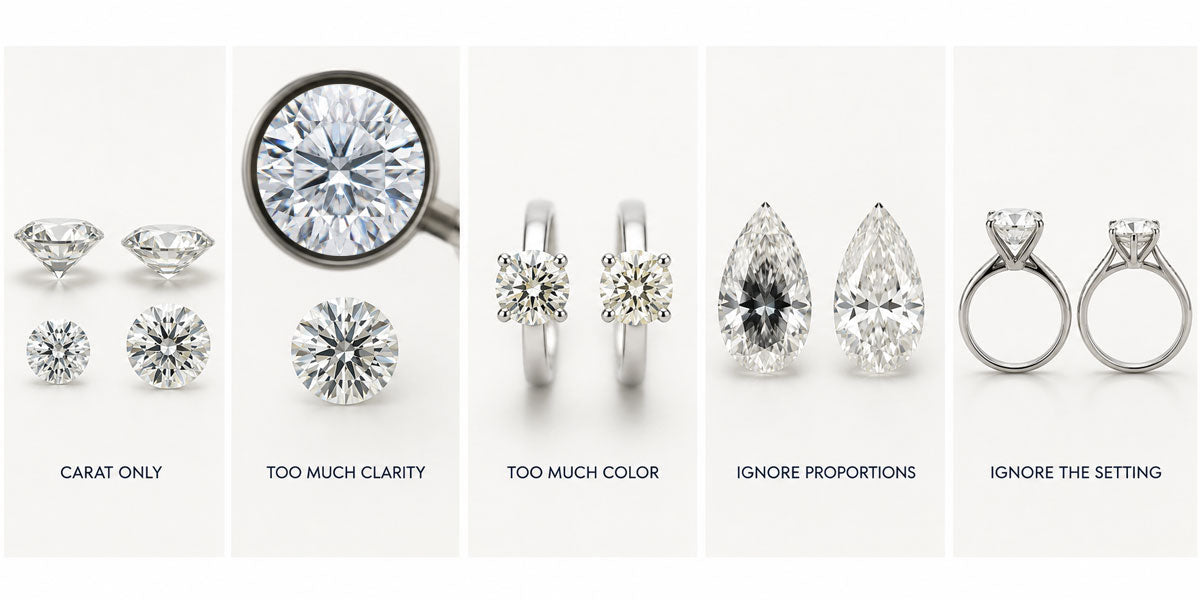
- Choosing maximum carat weight without evaluating cut or proportions.
- Paying for flawless clarity when an eye-clean diamond would look identical in normal wear.
- Automatically insisting on D color without considering shape and metal.
- Looking at carat weight without checking millimeter measurements.
- Ignoring bow-tie effects in elongated shapes.
- Assuming every diamond with similar grades will look the same.
- Focusing entirely on the center stone while ignoring setting quality.
- Confusing a grading report with an appraisal.
- Assuming laboratory-grown automatically means environmentally impact-free.
- Buying specifications rather than the appearance of the finished jewelry.
A Simple Lab Diamond Buying Formula
1. Shape
Pick the outline you love.
2. Cut
Prioritize strong light performance and attractive proportions.
3. Color
Choose a grade that looks appropriately white for the shape and setting.
4. Clarity
Aim for visually clean instead of automatically flawless.
5. Size
Compare carat weight with actual dimensions.
6. Setting
Make sure the mounting complements and protects the diamond.
Before You Buy: Final Checklist
- Is this the diamond shape you genuinely prefer?
- Does the diamond look bright and lively?
- Are its proportions attractive?
- Does the color look good in the intended metal?
- Is the clarity visually acceptable?
- Have you compared physical dimensions as well as carat weight?
- For elongated shapes, is any bow-tie effect acceptable?
- Does available documentation clearly identify laboratory-grown origin?
- Is the setting secure and well suited to the diamond?
- Does the entire piece fit comfortably within the budget?
- Are you buying it because you love the jewelry rather than because you expect the diamond to appreciate?
Shopping Lab Diamonds at Robinson's Jewelers
Robinson's Jewelers offers a broad selection of lab diamond jewelry across rings, earrings, necklaces, bracelets, studs, pendants, tennis jewelry, and other fine-jewelry styles. That range makes it possible to compare shapes, sizes, metals, settings, total carat weights, and design approaches rather than being limited to only a few predetermined options.
Robinson's Jewelers is family-owned by Andrew and Tracy Robinson and has served more than 35,000 clients. Owner Andrew Robinson is a GIA Gemologist, bringing professional gemological knowledge to the process of understanding and selecting diamond jewelry.
If you are still deciding whether laboratory-grown or natural origin is right for you, start with Why Choose Lab Diamonds? and Lab vs. Natural Diamonds. To understand individual quality factors more deeply, explore The 4Cs and Diamond Shapes.
Frequently Asked Questions About Buying Lab Diamonds
What should I prioritize when buying a lab diamond?
Start with the shape you prefer, then prioritize cut and visual performance. Choose color and clarity levels that look attractive rather than automatically paying for the highest grades, and compare physical dimensions along with carat weight.
What is a good clarity grade for a lab diamond?
There is no single ideal grade. Many shoppers look for an eye-clean diamond whose inclusions are not readily visible during normal viewing. The appropriate clarity depends on size, shape, inclusion type, and location.
What color lab diamond should I buy?
D through F represents the colorless range, but G through J can offer excellent value and may still appear very white depending on the shape, size, setting, and viewer.
Is a bigger lab diamond always better?
No. Greater carat weight does not guarantee better proportions, sparkle, or appearance. A slightly smaller diamond with better cut and dimensions can be considerably more beautiful.
Should a lab diamond have a grading report?
Independent gemological documentation can be valuable for significant stones because it provides standardized information and confirms laboratory-grown origin.
Are HPHT diamonds better than CVD diamonds?
Not automatically. Both methods can produce high-quality diamonds. The finished stone's appearance, proportions, color, clarity, and overall quality are generally more important to the shopper than the growth method alone.
Is a lab diamond a good choice for an engagement ring?
It can be an excellent choice. Lab diamonds offer diamond's beauty and durability while often allowing significantly greater flexibility in center-stone size, specifications, and setting design for the budget.
Find Your Lab Diamond Jewelry
Shop rings, earrings, necklaces, bracelets, tennis jewelry, and newly added lab diamond designs.