Lab vs. Natural Diamonds
A clear comparison of origin, appearance, rarity, grading, pricing, and the reasons shoppers choose each.
Lab-grown and natural diamonds are both diamonds, but they come from very different origins and operate in very different markets. To the unaided eye, comparable lab and natural diamonds can look virtually identical. Both can offer exceptional brilliance, hardness, beauty, and durability. The most important differences involve how they formed, rarity, pricing, supply, resale considerations, and the personal meaning a shopper attaches to natural versus laboratory origin.
The simple version: natural diamonds offer geological rarity and a formation story measured on an extraordinary timescale. Lab diamonds offer the same fundamental diamond material with dramatically greater flexibility in size, quality, and design for the budget.
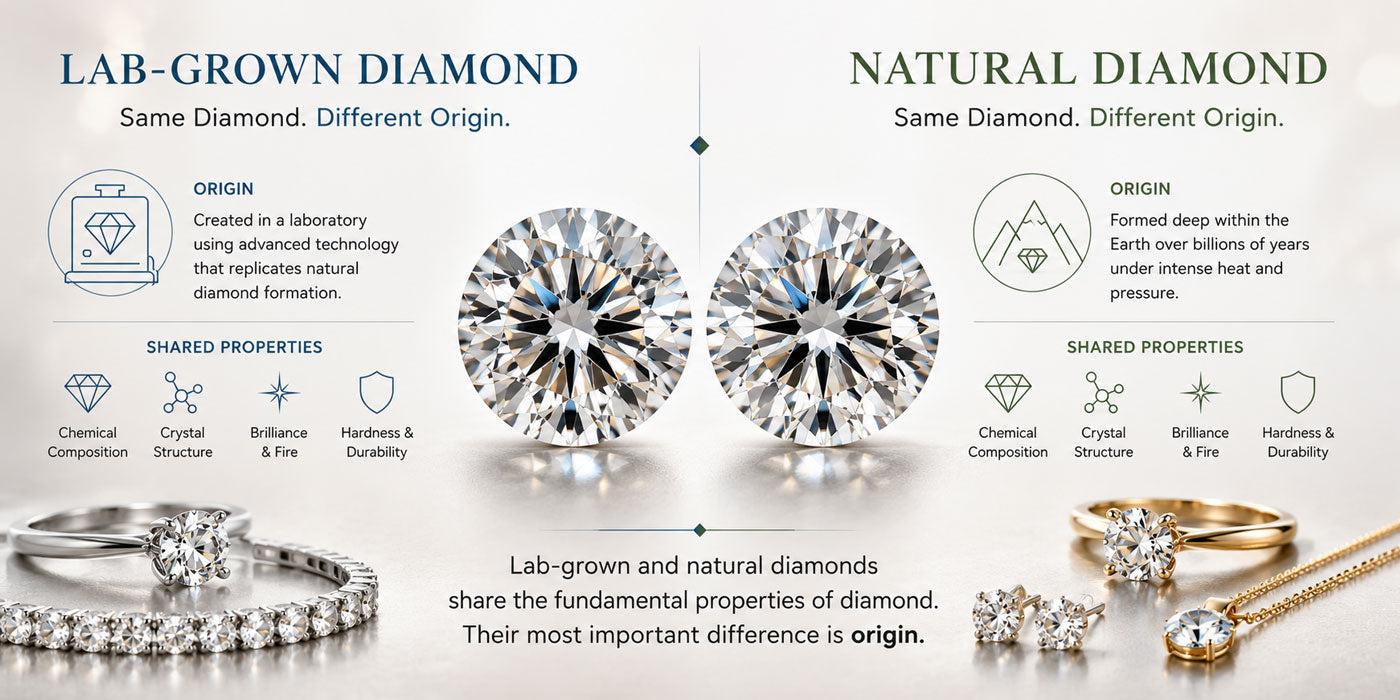
Lab vs. Natural Diamonds at a Glance
| Factor | Lab-Grown Diamond | Natural Diamond |
|---|---|---|
| Material | Diamond | Diamond |
| Primary Composition | Crystalline carbon | Crystalline carbon |
| Appearance | Can appear virtually identical to a comparable natural diamond | Can appear virtually identical to a comparable lab-grown diamond |
| Hardness | Exceptional diamond hardness | Exceptional diamond hardness |
| Origin | Created using controlled technological growth processes | Formed naturally within the Earth |
| Formation | Produced over a comparatively short period | Created through natural geological processes over immense timescales |
| Supply | Production can expand as technology and capacity increase | Limited by geological occurrence, recovery, and existing supply |
| Typical Purchase Price | Generally substantially lower for comparable size and quality | Generally higher, reflecting natural rarity and market structure |
| Grading | Can be independently evaluated and documented | Can be independently evaluated and documented |
| Identification | Reliable origin determination may require specialized gemological equipment | Reliable origin determination may require specialized gemological equipment |
| Secondary Market | Less established and affected by continuing changes in new-stone pricing | Longer-established, although resale prices still vary significantly |
Both Are Diamonds
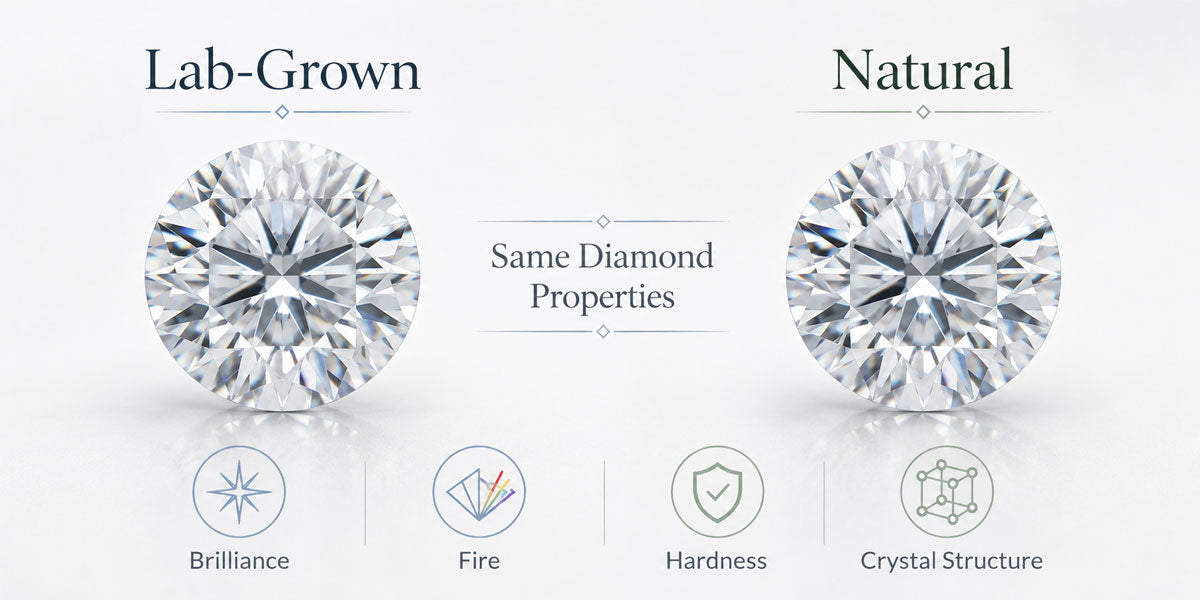
The most important point to understand is that a laboratory-grown diamond is not a diamond imitation. It is not cubic zirconia, glass, or moissanite.
Lab-grown diamonds consist of diamond material and share essentially the same chemical composition, crystal structure, physical characteristics, and optical properties associated with natural diamonds.
That means both categories can display exceptional brilliance, fire, scintillation, hardness, and durability.
The Fundamental Difference Is Origin
A natural diamond originated through geological processes within the Earth. A laboratory-grown diamond formed in a controlled technological environment designed to create conditions in which diamond crystal can grow.
That difference in origin affects rarity, supply, pricing, market behavior, and the emotional meaning some buyers attach to the stone.
Natural Diamond
A naturally occurring geological material valued partly for its rarity, age, and extraordinary natural formation history.
Lab-Grown Diamond
Diamond created through advanced technology, allowing production to expand independently of geological discovery.
How Natural Diamonds Form
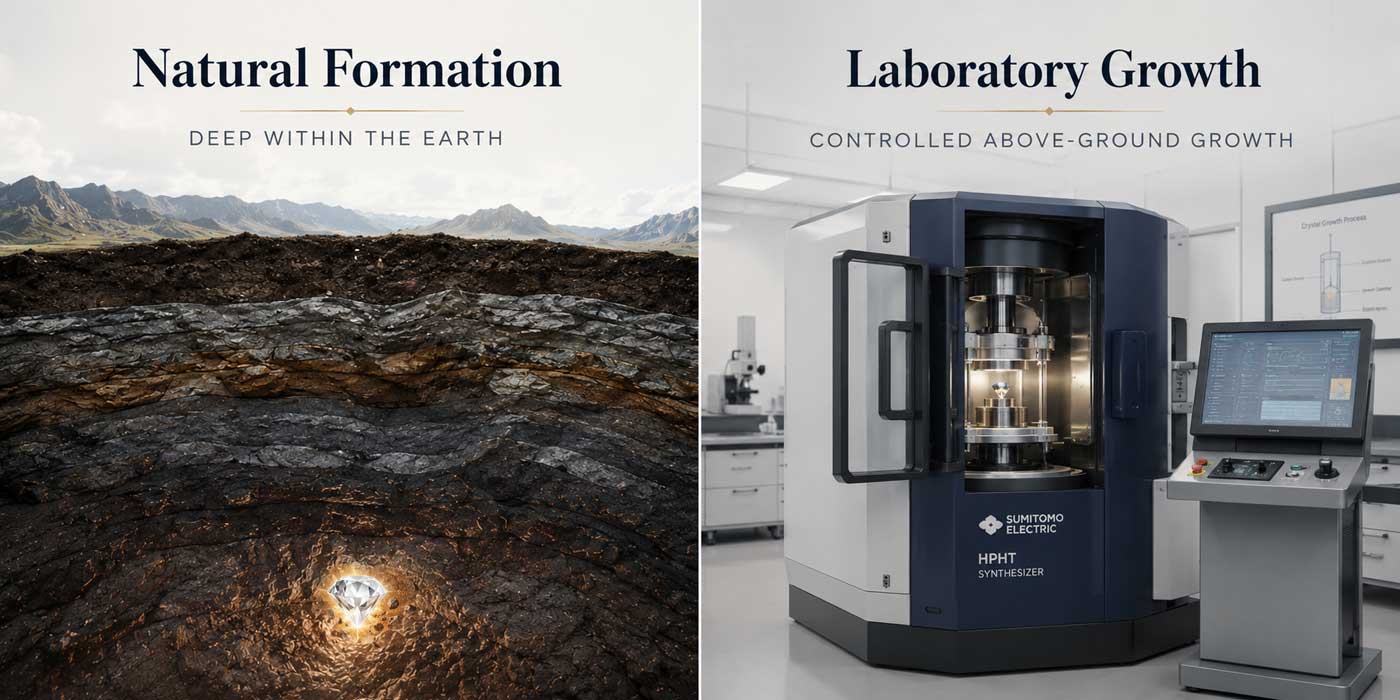
Natural diamonds formed deep within the Earth under extraordinary conditions involving heat and pressure. Carbon crystallized into diamond, and geological processes eventually transported some of those diamonds closer to the surface.
Their natural origin is inseparable from their appeal. Every natural diamond represents material created by geological processes long before the jewelry containing it existed.
For many shoppers and collectors, that rarity and natural history carry emotional value beyond appearance alone.
How Lab Diamonds Are Created
Most gem-quality laboratory-grown diamonds are produced using one of two major methods: High Pressure High Temperature, commonly called HPHT, or Chemical Vapor Deposition, commonly called CVD.
HPHT
High Pressure High Temperature growth uses intense pressure and heat to create conditions that allow carbon to crystallize as diamond.
CVD
Chemical Vapor Deposition uses carbon-containing gases and a diamond seed, allowing diamond material to form progressively over time.
These different growth histories can leave characteristics that gemological laboratories detect with specialized testing, even when the finished stones appear extremely similar in ordinary viewing.
Can You Tell the Difference by Looking?
In many cases, not reliably.
A natural diamond and laboratory-grown diamond with similar shape, cut, color, clarity, and carat weight can look extremely similar to the unaided eye.
Professional identification may involve specialized instruments that evaluate growth structures, fluorescence behavior, spectroscopy, inclusions, and other characteristics associated with the stone's origin.
Appearance alone is not a dependable test of origin. Clear disclosure and appropriate gemological documentation are therefore important when buying significant diamond jewelry.
Do Lab Diamonds Sparkle Like Natural Diamonds?
Yes, they can.
Sparkle is primarily influenced by the finished diamond's cut, proportions, facet arrangement, polish, symmetry, and interaction with light—not simply whether the diamond formed naturally or in a laboratory.
A beautifully cut lab diamond can be brighter and more visually impressive than a poorly proportioned natural diamond. The reverse is equally true.
For shoppers concerned primarily with brilliance, the quality of the individual stone matters much more than origin alone.
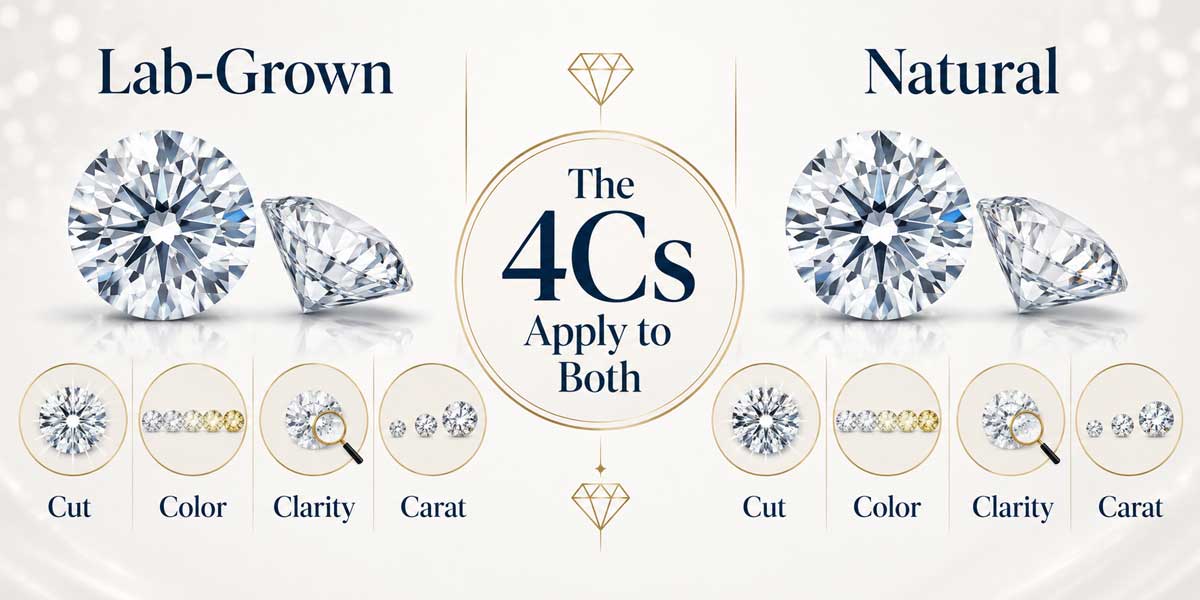
Cut, Color, Clarity and Carat Apply to Both
Natural and laboratory-grown diamonds both vary in cut, color, clarity, carat weight, proportions, dimensions, symmetry, and overall appearance.
Neither category automatically guarantees an ideal diamond.
For a deeper explanation of these quality characteristics, visit The 4Cs of Diamonds.
The Biggest Practical Difference for Many Shoppers: Price
Laboratory-grown diamonds generally sell for substantially less than natural diamonds with broadly comparable size and quality characteristics.
That pricing difference changes the buying equation dramatically.
Choose a Larger Stone
A budget that buys a smaller natural diamond may allow a significantly larger laboratory-grown diamond.
Increase Total Carat Weight
Tennis bracelets, necklaces, studs, and multi-stone jewelry can become considerably more accessible.
Upgrade the Setting
More of the budget can remain available for platinum, side stones, pavé, or elaborate craftsmanship.
Increase Quality
Some shoppers keep the desired size and instead choose higher color, clarity, or cut specifications.
Why the Price Difference Can Be So Large
The supply structures are fundamentally different.
Natural diamonds depend on geological occurrence, mining, recovery, existing inventories, and secondary-market supply. New natural diamonds cannot simply be manufactured when demand increases.
Laboratory-grown diamond production can expand as equipment, technology, efficiency, and manufacturing capacity increase.
As production has scaled and technology has improved, the cost of creating lab-grown diamonds has declined significantly. Increased supply has placed continuing pressure on market prices.
This is both the great advantage and the important economic tradeoff of lab diamonds. Falling production costs create extraordinary buying power today, while also making future values harder to predict.
Size Can Become a Very Different Conversation
The economics of lab-grown diamonds can make carat weights that were once financially impractical accessible to a much broader group of shoppers.
That is particularly noticeable with large center stones, matched diamond studs, tennis necklaces, tennis bracelets, and statement jewelry containing substantial total diamond weight.

Natural Diamonds Have Geological Rarity
Natural diamonds cannot be reproduced on demand. Their availability is inherently constrained by what formed naturally and what can be recovered or re-enter the market.
Some natural diamonds are especially rare because they combine exceptional size, color, clarity, provenance, or unusual natural characteristics.
For collectors, rarity itself may be central to the purchase. In that context, natural origin is not a technical footnote—it is part of what is being collected.
Lab Diamonds Have Expandable Supply
Laboratory-grown diamond supply operates differently. Additional production capacity can create additional diamonds.
That does not mean every lab diamond is identical or that producing high-quality diamonds is effortless. Individual stones still vary substantially.
But there is no equivalent geological constraint on the total long-term supply.
This difference helps explain both their compelling purchase prices and the different economics of their secondary market.
What About Resale Value?
This deserves a straightforward answer.
Neither category should automatically be purchased as a guaranteed financial investment.
Natural diamonds have a far longer-established secondary market, and geological rarity provides a fundamentally different supply backdrop. Even so, the amount a natural diamond can be resold for may differ significantly from its original retail price.
Laboratory-grown diamonds generally have a less established secondary market, and continued reductions in production costs and new-stone prices can place significant pressure on the value of previously purchased stones.
If future resale is a major purchasing priority, understand the distinction before buying. If the goal is maximum beauty, scale, and enjoyment for today's budget, lab diamonds can be extraordinarily compelling.
Natural Diamonds and Collectibility
Natural diamonds can also exist within categories where value extends beyond the basic 4Cs.
Important provenance, historical jewelry, designer attribution, exceptional fancy color, unusual size, rarity, or estate significance can make an individual natural diamond or piece of jewelry collectible in ways that are not directly comparable with mass-produced modern stones.
This is especially relevant in estate and vintage jewelry, where the entire piece may have historical, artistic, and designer significance.
Lab Diamonds and Jewelry Design
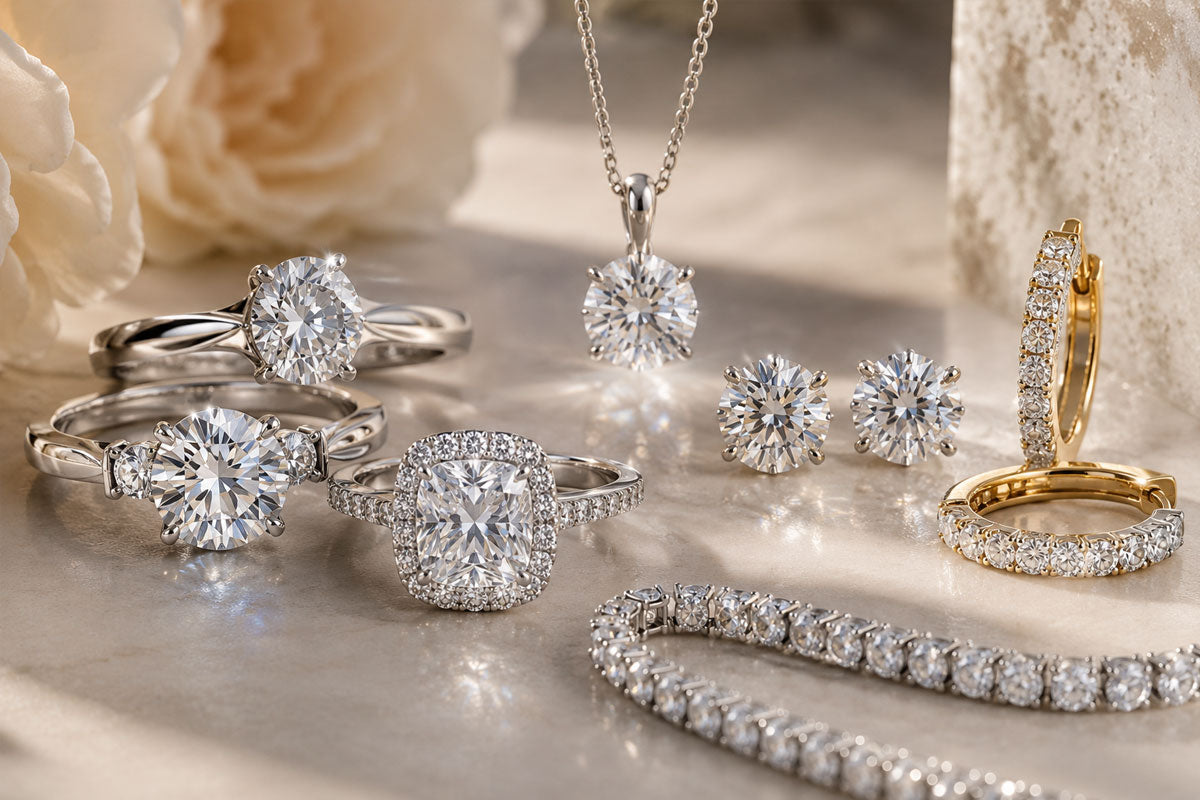
Lab diamonds offer designers and shoppers much greater freedom to use diamond extensively.
Large center stones, full diamond collars, high-carat tennis bracelets, substantial studs, multi-row jewelry, statement rings, and diamond-intensive fashion pieces can be produced at prices that would be dramatically higher using comparable natural diamonds.
For someone who primarily wants the finished visual effect, this can be transformative.
What About Sustainability?
Environmental comparisons are more complicated than simply assuming one origin is automatically better.
Natural diamond mining can involve land use, infrastructure, energy, water, and other environmental impacts.
Laboratory-grown diamond production also requires energy, and its environmental footprint can vary substantially depending on the growth technology, efficiency of the facility, electricity source, location, and other operational factors.
For that reason, broad claims that every laboratory-grown diamond is automatically environmentally superior should be treated cautiously.
Shoppers who consider environmental impact a major purchasing factor should look for specific sourcing and production information rather than relying on origin terminology alone.
What About Ethics and Sourcing?
Origin alone does not answer every ethical question.
Natural diamond sourcing has led to major industry efforts involving traceability, responsible mining, labor practices, and conflict prevention.
Laboratory-grown diamonds avoid traditional mining but still involve manufacturing facilities, energy, workers, equipment, raw materials, and supply chains.
The most useful approach is to evaluate the specific seller, manufacturer, documentation, and sourcing claims rather than assuming either category is universally perfect.
Which Is Better for an Engagement Ring?
Either can make an exceptional engagement ring.
Consider Natural If...
The wearer values geological rarity, traditional symbolism, natural origin, or the idea of owning something formed by nature over an extraordinary timescale.
Consider Lab-Grown If...
The wearer prioritizes a larger center stone, higher specifications, a more elaborate setting, or maximizing visual impact within the budget.
The most important rule is simple: choose the type of diamond the person wearing the ring actually wants.
Which Is Better for Diamond Stud Earrings?
Lab-grown diamonds can be particularly attractive for diamond studs because visual size is a major part of their appeal.
A larger pair can create a significant difference in appearance, and lab-grown pricing may make substantial total carat weights much more accessible.
Natural diamond studs remain appealing to shoppers who place greater importance on natural origin or who simply prefer natural diamonds regardless of the price difference.
Which Is Better for Tennis Bracelets and Necklaces?
This is one of the categories where the economic difference becomes especially dramatic.
A tennis necklace can contain dozens—or even hundreds—of diamonds. As total carat weight increases, the difference between natural and lab-grown diamond pricing can become substantial.
Lab diamonds can therefore make large, high-impact tennis jewelry accessible at price points that would otherwise require considerably greater investment.
Natural diamond tennis jewelry remains compelling for shoppers who want the entire piece composed of naturally formed diamonds and value the rarity represented by that total carat weight.
Which Is Better for Collectors?
Natural diamonds generally have the stronger argument when the purchase is driven by rarity, provenance, geology, historical significance, estate value, designer importance, or collectibility.
Lab-grown diamonds are generally more compelling when the purchase is driven by visible beauty, scale, specifications, and value within a modern jewelry purchase.
How to Decide: Ask What You Are Actually Buying
The decision becomes easier once you identify your real priority.
| If You Care Most About... | Consider... |
|---|---|
| Geological rarity | Natural diamond |
| Maximum size for budget | Lab-grown diamond |
| Collector or estate significance | Natural diamond |
| Large diamond-intensive jewelry | Lab-grown diamond |
| Natural origin and geological story | Natural diamond |
| Higher specs within a fixed budget | Lab-grown diamond |
| Established secondary-market history | Natural diamond generally has the advantage |
| Maximum immediate visual value | Lab-grown diamond |
There Is No Universal Winner
The lab-versus-natural debate is often framed as though one category has to defeat the other. That is not especially useful for shoppers.
A person buying a rare natural diamond for its geological origin is making a different purchase from someone choosing a large lab diamond because they love the visual impact.
Both decisions can make sense.
The better diamond is the one that matches your priorities. Know what you are buying, understand why it is priced the way it is, and choose the stone and jewelry that give you the most satisfaction.
Compare the Individual Diamond
Once you have chosen natural or laboratory-grown origin, the actual diamond still needs to be evaluated.
- Choose a shape you genuinely like.
- Prioritize attractive cut and light performance.
- Select an appropriate color range.
- Look for sufficient clarity without automatically paying for microscopic perfection.
- Compare carat weight with actual millimeter dimensions.
- Review proportions and overall visual appearance.
- Consider the setting, metal, craftsmanship, and finished design.
- Review appropriate gemological documentation.
Continue with The 4Cs, explore Diamond Shapes, or follow the complete Lab Diamond Buying Guide.
Frequently Asked Questions About Lab vs. Natural Diamonds
Is a lab-grown diamond a real diamond?
Yes. Laboratory-grown diamonds are diamond material with essentially the same fundamental chemical composition, crystal structure, physical properties, and optical characteristics as natural diamonds.
Can you tell a lab diamond from a natural diamond just by looking?
Not reliably in many cases. Specialized gemological testing and equipment may be needed to determine origin.
Do lab diamonds sparkle differently?
Origin alone does not determine sparkle. Cut, proportions, polish, symmetry, facet arrangement, and the quality of the individual diamond have a much greater effect on light performance.
Why are lab diamonds so much less expensive?
Lab-grown diamond supply can expand through manufacturing, and improvements in technology and production efficiency have reduced costs. Natural diamond supply is constrained by geological occurrence and recovery.
Are natural diamonds rarer?
Yes. Natural diamonds are geological materials whose supply is limited by what formed naturally and what can be recovered or re-enter the market.
Do natural diamonds hold value better?
Natural diamonds have a longer-established secondary market and inherently limited geological supply, but resale prices can still differ substantially from original retail prices. Lab-grown diamonds face additional pricing pressure from expanding production and declining manufacturing costs.
Which should I choose?
Choose according to your priorities. Natural diamonds emphasize geological rarity and origin. Lab-grown diamonds generally provide greater flexibility in size, specifications, and jewelry design for the budget.
Find Your Lab Diamond Jewelry
Shop rings, earrings, necklaces, bracelets, tennis jewelry, and newly added lab diamond designs.