Diamond Shapes
Compare the silhouettes, proportions, sparkle patterns, and personalities of today’s most popular diamond shapes.
Diamond shape has a huge effect on how a piece of jewelry looks, even before color, clarity, or carat weight enter the conversation. Some shapes emphasize sparkle, some create a long elegant outline, some feel architectural and refined, and others make a diamond appear larger for its weight. Choosing the right shape is less about finding a universally “best” diamond and more about finding the silhouette, proportions, and personality that suit the wearer and the design.
Shape and cut are not the same thing. Shape describes the diamond’s outline, such as round, oval, pear, or emerald. Cut quality describes how well the diamond’s proportions and facets work together to return light.
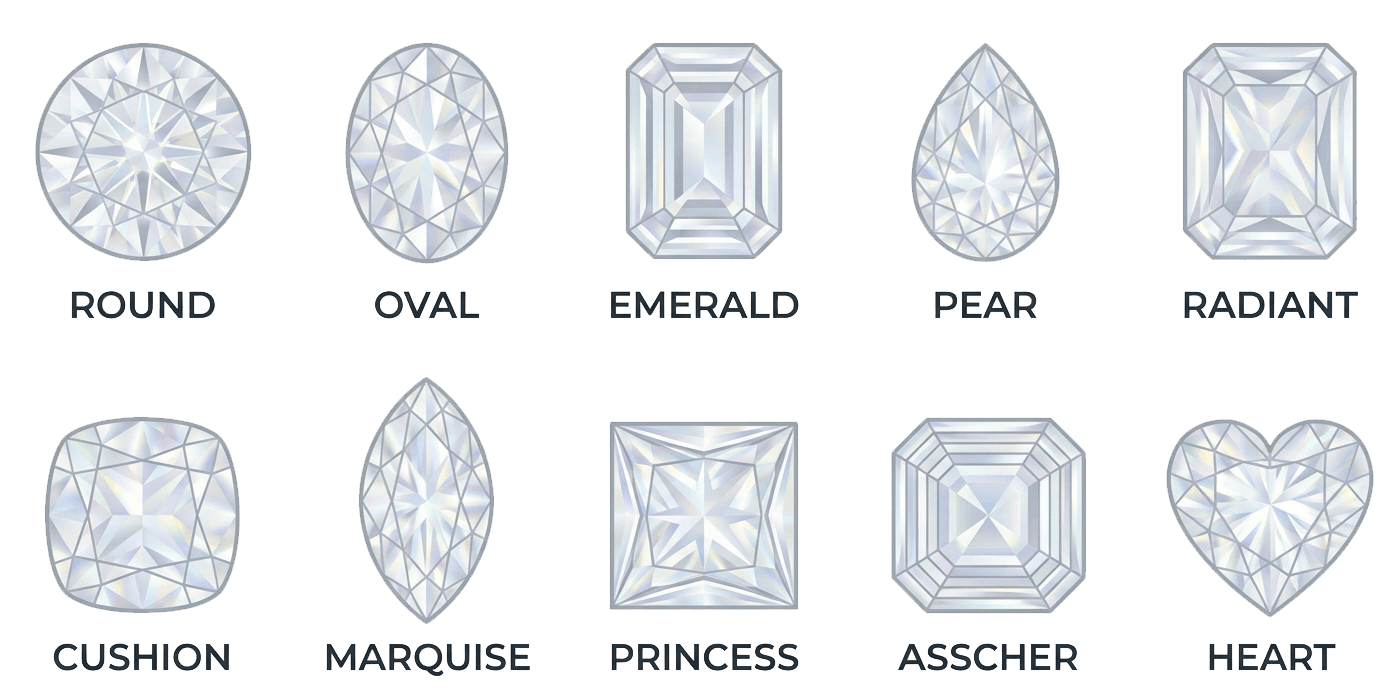
Popular Diamond Shapes at a Glance
Round
Classic, symmetrical, highly brilliant, and extremely versatile.
Oval
Elegant and elongated with excellent visual spread and lively brilliance.
Emerald
Long step facets create a sophisticated, mirror-like appearance.
Pear
A graceful teardrop shape combining curves with a dramatic point.
Radiant
Brilliant faceting paired with a crisp rectangular or square outline.
Cushion
Soft corners and a romantic silhouette with many facet variations.
Marquise
Long and dramatic with pointed ends and excellent apparent size.
Princess
A modern square shape known for strong brilliance and clean geometry.
Asscher
Square step-cut geometry with a distinctive vintage, architectural look.
Heart
A recognizable romantic silhouette that rewards careful symmetry.
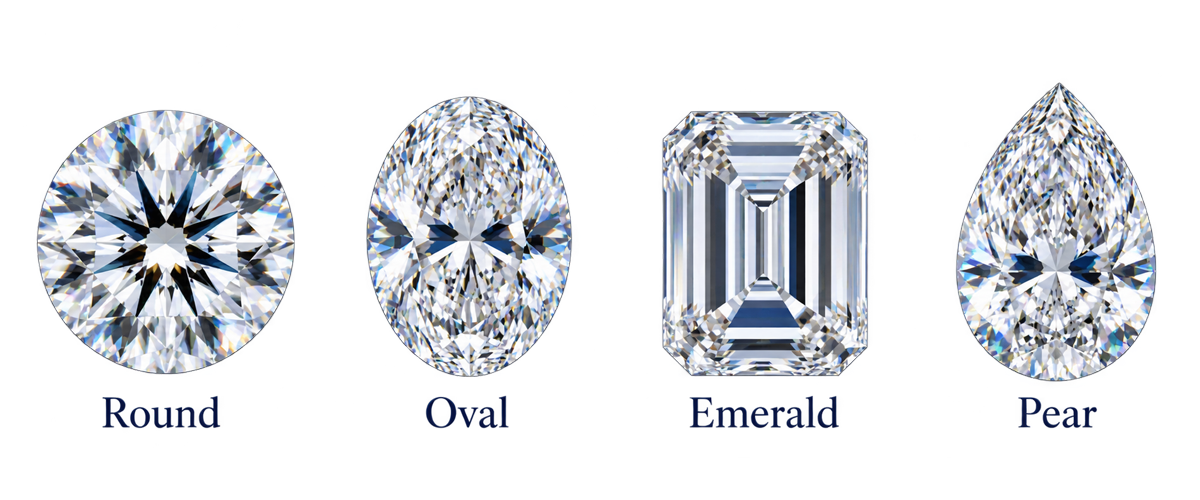
Round Brilliant Diamonds
The round brilliant is the most recognized diamond shape and remains a benchmark for sparkle. Its symmetrical outline and carefully arranged facet pattern are designed to maximize light return when proportions are well executed.
Round diamonds work in almost every jewelry style, from solitaire engagement rings and halo designs to stud earrings, pendants, tennis bracelets, and multi-stone pieces. Their symmetry also makes them easy to match in pairs or groups.
Because round diamonds are so popular and typically require more rough material to be removed during cutting, they often command a higher price per carat than many fancy shapes.
Best for: shoppers who want classic brilliance, easy pairing, timeless styling, and broad setting compatibility.
Oval Diamonds
Oval diamonds combine brilliant-style faceting with an elongated outline. Their length can create a larger visual footprint on the finger and can make the hand appear longer and more slender.
One reason oval diamonds are popular is that they can offer strong apparent size. Two diamonds with the same carat weight can look noticeably different face-up depending on proportions, and an oval often spreads its weight over a larger visible area than a round diamond.
Oval diamonds can display a darker area across the center known as a bow-tie effect. Some bow-tie is common, but excessive darkness can distract from the stone’s appearance. This is one reason viewing the individual diamond matters.
Best for: elegant engagement rings, larger visual presence, elongated proportions, and shoppers who like brilliant sparkle with a softer outline.
Emerald-Cut Diamonds
Emerald-cut diamonds look very different from brilliant-cut shapes. Instead of many small triangular and kite-shaped facets designed for intense sparkle, emerald cuts use broad step facets that create flashes of light and a dramatic hall-of-mirrors effect.
The elongated rectangular outline feels clean, sophisticated, and architectural. Because the large open facets make the interior of the stone easier to see, clarity can be more visually noticeable in an emerald cut than in many brilliant-style shapes.
Emerald cuts also tend to reveal body color more readily than highly brilliant round diamonds, especially at larger sizes.
Best for: refined, understated luxury; Art Deco-inspired jewelry; clean lines; and shoppers who prefer broad flashes of light over intense scintillation.
Pear-Shaped Diamonds
Pear-shaped diamonds combine a rounded end with a single pointed tip, creating a teardrop silhouette. They can feel romantic, elegant, or dramatic depending on the proportions and setting.
Pear diamonds are often oriented with the point toward the fingertip in rings, though there is no rule requiring that direction. They also work beautifully in pendants and drop earrings because the shape naturally creates movement and direction.
Like ovals and marquise diamonds, pears can display a bow-tie effect. Symmetry is especially important because an uneven outline can be easy to notice.
Best for: distinctive engagement rings, pendants, drop earrings, elegant elongation, and shoppers who want something less conventional than round or oval.
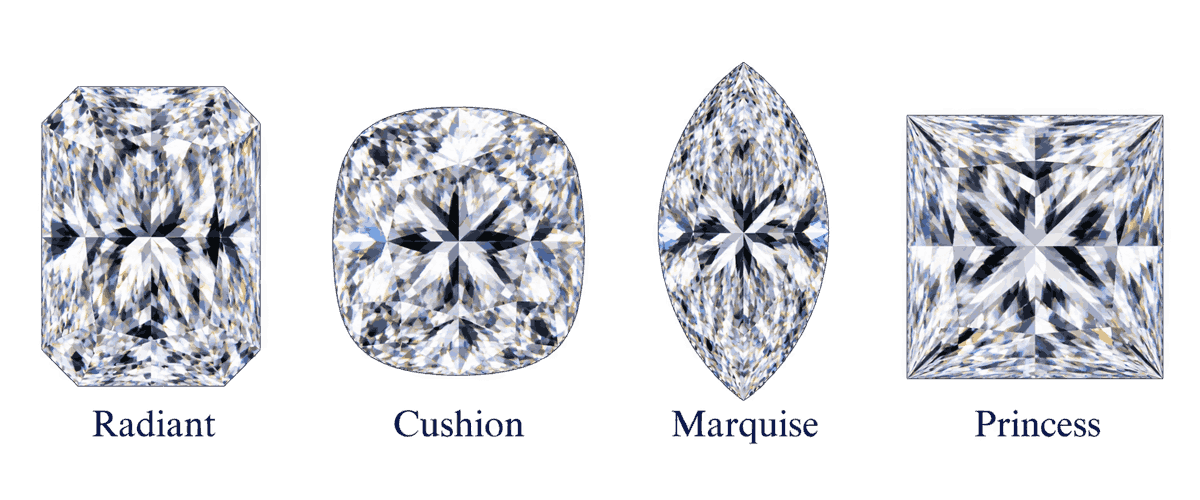
Radiant-Cut Diamonds
Radiant diamonds combine a rectangular or square outline with brilliant-style faceting. The result is a shape that has some of the clean geometry associated with emerald cuts but considerably more scintillation.
Radiants can have cropped corners, which gives them a durable and distinctive outline. They are available in both square and elongated proportions, making them versatile for different ring styles.
Because radiant diamonds break light into many smaller flashes, they can sometimes disguise inclusions more effectively than step-cut shapes.
Best for: shoppers who like rectangular diamonds but want more sparkle than an emerald cut typically provides.
Cushion-Cut Diamonds
Cushion diamonds have a square or rectangular outline with softened corners, creating a pillow-like appearance. They have existed in different forms for generations and can range from antique-inspired to very modern depending on the facet pattern.
Some cushion diamonds display broad, chunky flashes of light, while others have a more splintered or crushed-ice appearance. Neither style is automatically better; they simply create different visual effects.
Cushions can also vary substantially in length-to-width ratio, from nearly square to noticeably elongated.
Best for: romantic settings, vintage-inspired jewelry, halos, soft silhouettes, and shoppers who enjoy a less rigid geometric shape.
Marquise Diamonds
The marquise shape features an elongated body with pointed ends. Its long outline can create exceptional apparent size and dramatic finger coverage relative to carat weight.
Marquise diamonds have a distinctive history and an unmistakable silhouette. They can look elegant in classic solitaire settings or surprisingly modern when oriented east-west across the finger.
Symmetry and point protection are important. The tips should be secure in the setting because pointed areas can be more vulnerable to damage than rounded edges.
Best for: maximum visual spread, dramatic designs, elongated fingers, vintage influence, and distinctive engagement rings.
Princess-Cut Diamonds
Princess-cut diamonds are typically square with pointed corners and brilliant-style faceting. They offer a crisp geometric look while still delivering substantial sparkle.
They became especially popular in modern engagement jewelry because they provide a strong contrast to the traditional round brilliant while still feeling familiar and versatile.
The pointed corners deserve protection in the setting, commonly through prongs positioned over each corner.
Best for: modern square styling, geometric engagement rings, strong brilliance, and shoppers who prefer sharper lines.
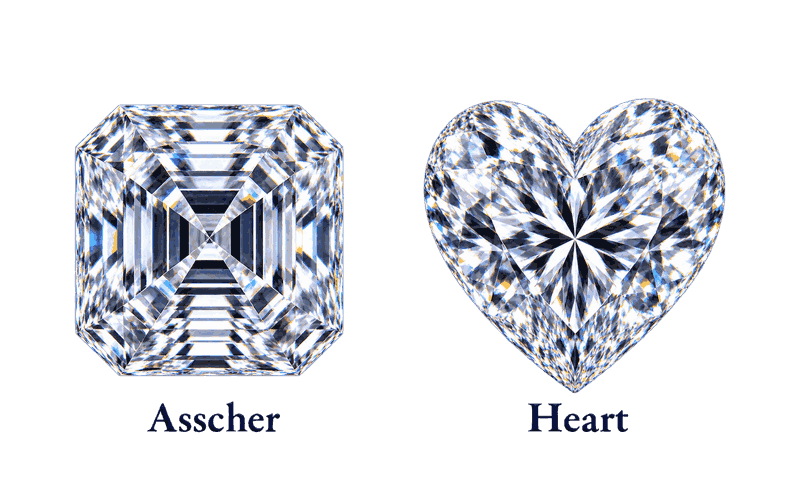
Asscher-Cut Diamonds
Asscher diamonds are step-cut stones with a square outline, cropped corners, and a highly geometric facet pattern. Viewed face-up, they can create concentric squares and a mesmerizing depth effect.
Like emerald cuts, Asschers emphasize clarity and structure rather than rapid-fire sparkle. Their proportions often create a distinctive vintage or Art Deco character.
Because of their depth, Asscher diamonds may appear somewhat smaller face-up than some other shapes of the same carat weight.
Best for: Art Deco style, architectural design, vintage-inspired rings, and shoppers who appreciate symmetry and step-cut optics.
Heart-Shaped Diamonds
Heart-shaped diamonds are one of the most recognizable fancy shapes. They combine brilliant-style faceting with a symbolic silhouette, making them especially popular for romantic gifts and highly personal jewelry.
Symmetry is critical. The two lobes should appear balanced, and the cleft and point should be clearly defined. Very small heart-shaped diamonds can sometimes lose some of the visual definition of the shape.
Best for: romantic gifts, meaningful pendants, statement rings, and shoppers who want a clearly symbolic diamond shape.
Which Diamond Shapes Look Largest?
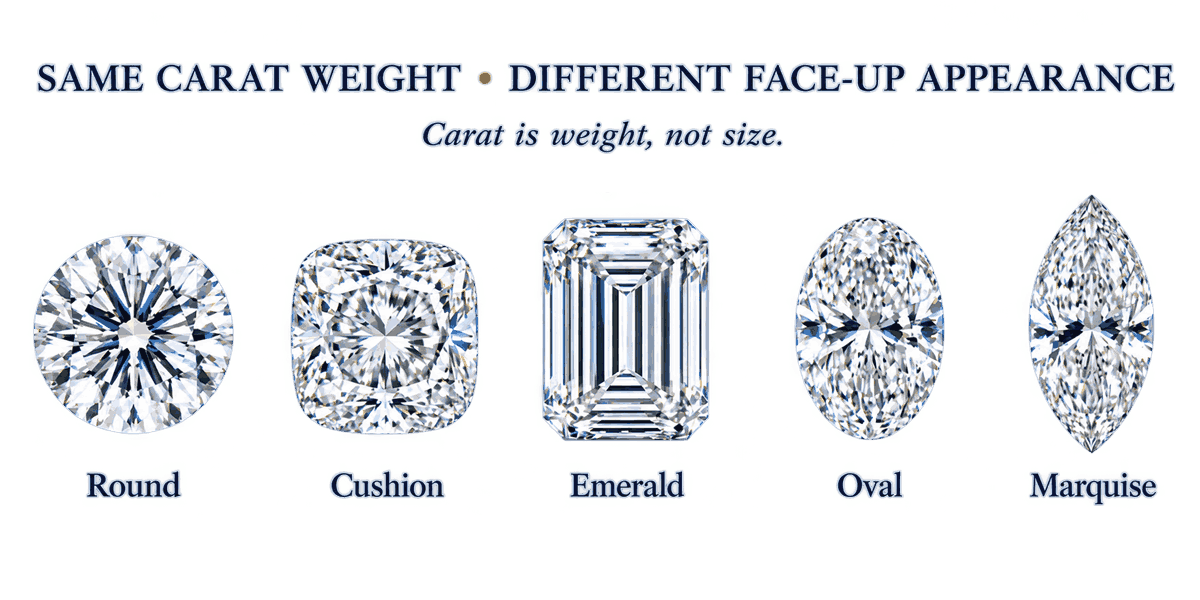
Carat measures weight, not visible diameter or surface area. This means two one-carat diamonds can look very different in size when viewed from above.
Elongated shapes often provide excellent visual spread because more of their weight extends across the visible surface.
Excellent Visual Spread
Oval, marquise, and pear diamonds often appear large relative to carat weight because of their elongated outlines.
Strong Rectangular Presence
Emerald and radiant cuts can create substantial finger coverage, particularly in elongated proportions.
Depth Matters
Diamonds that carry more weight below the girdle may appear smaller face-up even when the carat weight is identical.
Measurements Matter
Always compare millimeter dimensions alongside carat weight when visual size is important.
Understanding Length-to-Width Ratio
Length-to-width ratio describes the relationship between a diamond’s length and width. It is particularly useful when comparing elongated fancy shapes.
Two oval diamonds can have the same carat weight but look dramatically different if one is short and broad while the other is long and slender. The same is true for radiant, cushion, emerald, pear, and marquise shapes.
There is no single perfect ratio for every shopper. Some people prefer a fuller outline, while others strongly favor a more elongated look.
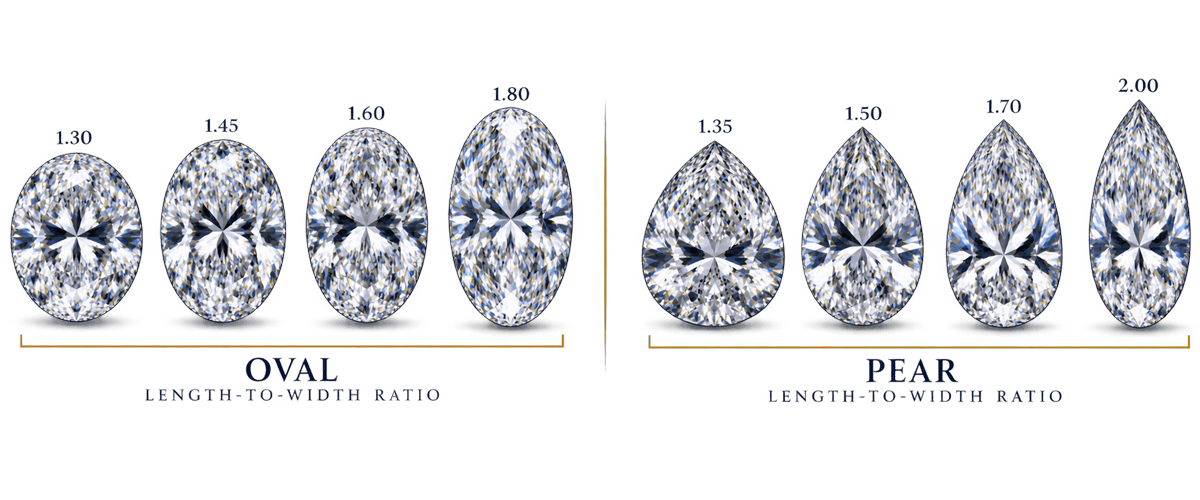
| Shape | Common Visual Choice | What Changes With Ratio |
|---|---|---|
| Oval | Moderately elongated | Can range from soft and full to long and slender |
| Emerald | Rectangular | Shorter ratios feel bolder; longer ratios feel more elegant |
| Radiant | Square or elongated | Can completely change the personality of the stone |
| Cushion | Square to elongated | Varies from classic pillow shape to modern elongated profile |
| Pear | Balanced elongation | Short pears look fuller; long pears look more dramatic |
| Marquise | Strongly elongated | Higher ratios create an increasingly slender appearance |
Which Shapes Hide Inclusions Best?
Brilliant-style facet patterns tend to create more visual activity, which can make some inclusions harder to notice with the unaided eye.
Round, radiant, cushion, princess, oval, pear, and marquise diamonds may therefore offer more flexibility in clarity selection than large step-cut stones.
Emerald and Asscher diamonds have broad open facets that can reveal inclusions more easily. For those shapes, shoppers may place somewhat greater emphasis on finding a visually clean stone.
This does not mean every emerald or Asscher diamond requires an exceptionally high clarity grade. What matters most is whether the individual diamond appears clean and attractive at normal viewing distance.
Which Shapes Show Color More Easily?
Diamond shape can influence how noticeable body color appears. Brilliant round diamonds are extremely efficient at returning light and may visually mask warmth better than some elongated or step-cut shapes.
Emerald, Asscher, pear, oval, marquise, cushion, and radiant diamonds can sometimes display color more noticeably, especially in larger sizes or near the ends of elongated shapes.
The metal also matters. Slight warmth may be less noticeable in yellow or rose gold than in bright white platinum or white gold.
Diamond Shape and Setting Style
The setting should complement the outline of the diamond and protect areas that need additional support.
- Round: works with almost every setting style.
- Oval: particularly strong in solitaires, halos, and three-stone designs.
- Emerald: pairs beautifully with clean solitaires, side baguettes, and Art Deco-inspired settings.
- Pear: benefits from protection at the pointed tip.
- Radiant: complements modern solitaires and three-stone rings.
- Cushion: works especially well with halos and romantic settings.
- Marquise: requires protection at both pointed ends.
- Princess: settings should protect all four corners.
- Asscher: pairs naturally with geometric and vintage-inspired designs.
- Heart: requires careful positioning to preserve the recognizable silhouette.
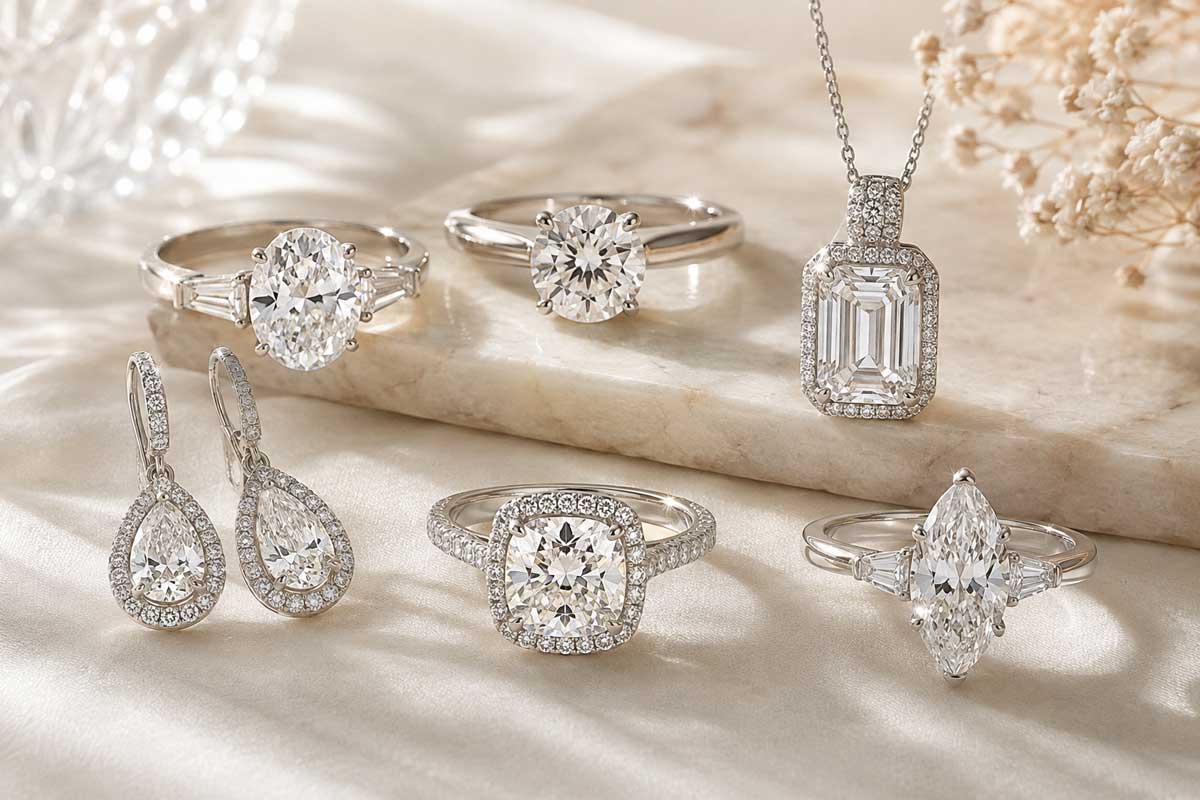
Diamond Shapes for Stud Earrings
Round diamonds remain the classic choice for studs, but fancy shapes can make a pair feel much more distinctive.
Oval, emerald, pear, cushion, princess, and radiant diamonds can all create beautiful stud earrings. Matching becomes especially important with fancy shapes because the pair should have similar proportions, outline, color, and overall visual character.
Lab-grown diamonds can be particularly attractive for larger diamond studs because the lower cost can make higher total carat weights more accessible.
Diamond Shapes for Pendants and Necklaces
Pendants offer enormous flexibility because there is no concern about finger shape or everyday impact against surrounding objects.
Round diamonds create a timeless look, while pears naturally form an elegant drop. Emerald and radiant diamonds can feel sleek and contemporary. Heart shapes emphasize symbolism, while marquise and oval diamonds create graceful vertical lines.
Choosing a Shape for a Lab Diamond
Lab-grown diamonds give shoppers considerable freedom to explore shape because larger stones may be achievable within the same budget compared with natural diamonds.
This can make shape selection even more important. As carat weight increases, proportions, bow-tie effects, facet patterns, color distribution, and overall visual personality become increasingly noticeable.
Rather than choosing a lab diamond simply because it is large, look for a combination of size and shape that actually performs beautifully.
How to Choose Your Diamond Shape
If you are unsure where to begin, think about the visual feeling you want rather than trying to memorize technical specifications.
Maximum Classic Sparkle
Start with round brilliant.
Elegant and Elongated
Consider oval, pear, marquise, or elongated radiant.
Clean and Sophisticated
Explore emerald or Asscher cuts.
Soft and Romantic
Look at cushion, oval, or pear shapes.
Modern and Geometric
Radiant, princess, emerald, and Asscher are strong choices.
Distinctive and Unexpected
Marquise, heart, pear, or unusual elongated shapes offer more personality.
Do Not Choose by Shape Alone
Shape is the starting point, not the entire diamond decision.
After choosing a silhouette, compare the individual stone’s cut quality, proportions, measurements, color, clarity, carat weight, and visual performance. For fancy-shaped diamonds in particular, two stones with similar grading information can look surprisingly different.
Use The 4Cs to understand the primary quality factors, then follow the Lab Diamond Buying Guide for a more complete shopping process.
Frequently Asked Questions About Diamond Shapes
Which diamond shape sparkles the most?
The round brilliant is specifically engineered for strong light return and is generally considered the benchmark for brilliance. Other brilliant-style shapes can also be extremely lively when well cut.
Which diamond shape looks largest?
Elongated shapes such as oval, marquise, and pear often provide excellent visible surface area relative to carat weight. Actual millimeter dimensions are more useful than carat weight alone when comparing apparent size.
What is the best diamond shape for an engagement ring?
There is no single best shape. Round is the most traditional, while oval, emerald, cushion, radiant, pear, and other fancy shapes offer very different personalities. The best choice is the shape the wearer actually prefers.
Which diamond shapes hide inclusions best?
Brilliant-style shapes generally create more visual activity and may disguise some inclusions better than step cuts. Emerald and Asscher diamonds tend to make internal characteristics easier to see.
What does elongated diamond mean?
An elongated diamond has noticeably greater length than width. Oval, pear, marquise, emerald, and radiant diamonds are commonly seen in elongated proportions.
Is a diamond's shape included in the 4Cs?
No. Shape is separate from the 4Cs. The 4Cs are cut, color, clarity, and carat weight, although shape can strongly influence how those characteristics appear.
Find Your Lab Diamond Jewelry
Shop rings, earrings, necklaces, bracelets, tennis jewelry, and newly added lab diamond designs.